Canon EOS R6 Mark III Review
Canon's best all-around mirrorless refines every winning formula into one body
Mirrorless · Full-Frame
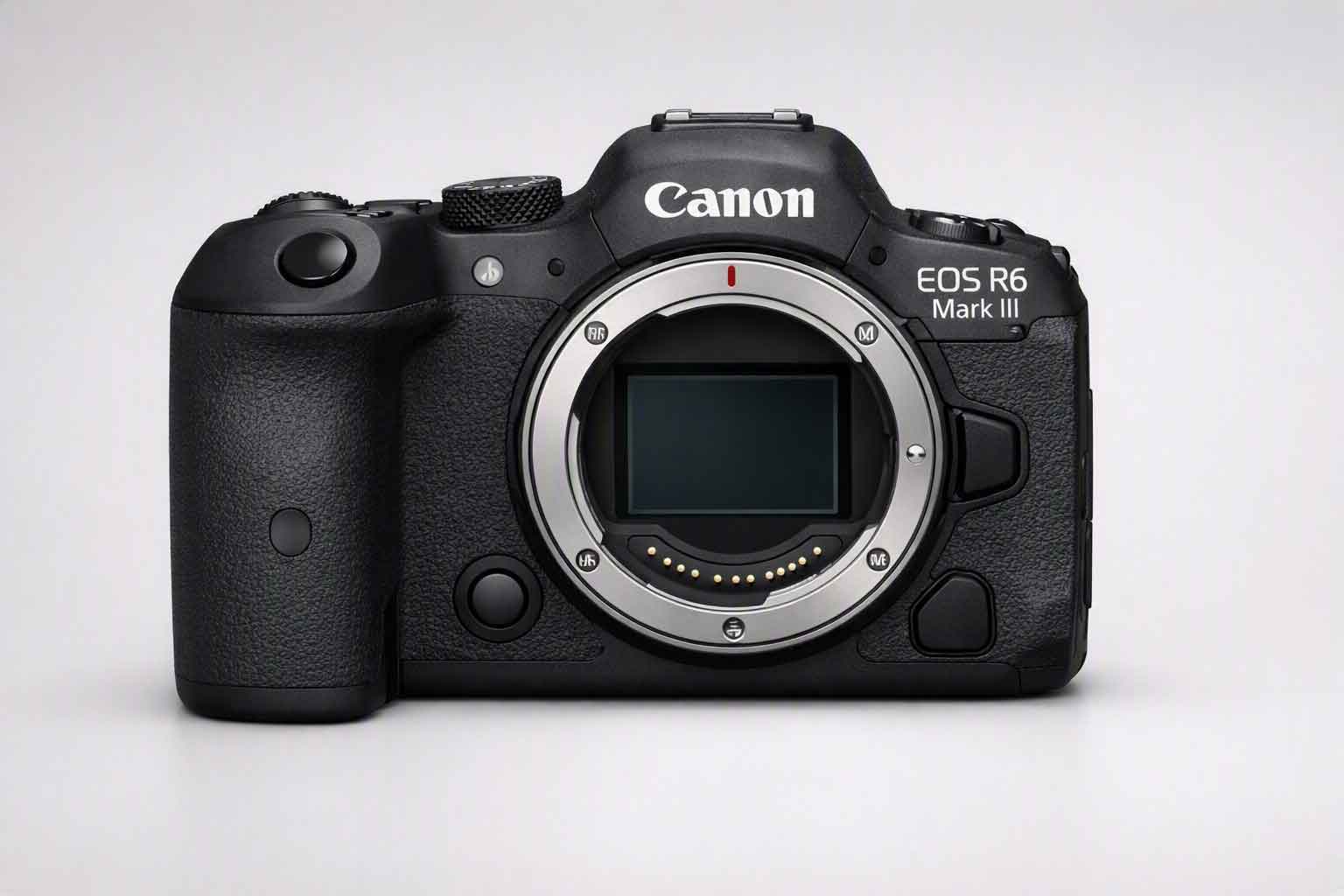
Canon's R6 Mark II was already a strong all-rounder, but the R6 Mark III answers the one criticism that stuck: sensor resolution. The jump from 20MP to 40MP transforms what was a capable speed-focused body into a genuine dual-threat system — one that can deliver the 40 fps electronic burst sports photographers need and the fine-detail resolving power landscape and portrait shooters demand. At $2,499 it sits at a compelling midpoint between Canon's entry RF cameras and the flagship R5 Mark II.
Design & Ergonomics
The R6 Mark III inherits Canon's proven R6 chassis — a deep, comfortable grip, logical top-plate dial arrangement, and an ergonomic button layout that rewards photographers who invest time in customization. At 670 g the body balances comfortably with mid-range RF lenses and handles long telephoto glass without strain. Dust and moisture sealing use Canon's established gasket system, offering reliable protection in mixed weather conditions.
The 3.69M-dot OLED EVF is among Canon's clearest, and the fully articulating 3.0-inch touchscreen covers every shooting orientation from ground-level to overhead. A newly refined top LCD panel provides at-a-glance status without menu access. The dual-card configuration — CFexpress Type B primary plus SD UHS-II secondary — mirrors the R5 Mark II's setup, keeping workflows consistent across Canon's professional RF lineup.
Image Quality
Forty megapixels from a full-frame sensor delivers image files that hold up under aggressive cropping — a capability the 20MP R6 Mark II simply could not match. Canon's color science here is warm and flattering without sacrificing accuracy: skin tones render with natural gradation, foliage separates cleanly from sky, and Canon's Picture Style engine gives JPEG shooters a reliable starting point across all lighting conditions.
Dynamic range is broad. Shadows can be lifted two to three stops in post without significant color noise, and highlights roll off gradually enough that recovery in raw processing is productive. High-ISO performance is excellent: ISO 6400 files show controlled luminance noise with pleasing color retention, and ISO 12800 is editorial-ready for web delivery. Canon's DIGIC X processor applies in-camera noise reduction intelligently — JPEG files at high ISO look cleaner than raw files processed aggressively, which is worth bearing in mind for event photographers who rely on fast in-camera delivery.
Autofocus Performance
Canon's Dual Pixel CMOS AF II in the R6 Mark III is one of the most reliable subject-tracking systems available at any price. The 1,053-zone coverage spans the full sensor width and height, and subject detection across Human, Animal, and Vehicle categories is confident and consistent. Eye tracking in particular is exceptional — the camera maintains lock on subjects even as they turn away, partially obstruct themselves, or move through low-contrast backgrounds.
At 40 fps electronic burst, DPAF II tracks moving subjects — athletes, pets, motorsport — with an accuracy that keeps keepers-per-burst ratios high. The system handles scene transitions (subject entering frame, switching from background to subject) faster than competing systems. Canon's Subject Detection Priority mode, which allocates AF resources to registered subject types first, is particularly effective for sports events where background distractions are unavoidable.
Video Capabilities
Canon's R6 Mark III makes a strong case as a hybrid video body. The 4K/60p mode is oversampled from a 6K sensor readout — producing sharp footage free of the moire and aliasing that plagued earlier lower-resolution Canon bodies. The 4K/120p high-frame-rate option is cropped slightly but still pulls from enough sensor real estate to deliver convincing slow-motion detail. FHD/180p enables very smooth motion at moderate resolution.
Canon Log 3 is available for professional color grading, and 10-bit internal recording gives colorists the headroom to push grades without clipping. The 8-stop IBIS system works cooperatively with Canon's IS-equipped RF lenses to achieve up to 8 combined stops of stabilization — handheld footage looks as smooth as many gimbal-stabilized shoots at equivalent focal lengths. A full-size HDMI port ensures clean 4K output without resolution limits, and USB-C supports both tethering and camera power from an external source during long recording sessions.
Pros & Cons
Pros
- 40MP sensor is a meaningful upgrade — doubles the pixel count of the R6 Mark II
- 40 fps electronic burst with DPAF II tracking is exceptional for action
- 8-stop IBIS among the best in full-frame mirrorless
- 4K/60p from a 6K oversampled readout is exceptionally sharp
- DPAF II subject detection is intuitive and fast across all categories
- Fully articulating touchscreen suits a wide range of shooting styles
- $2,499 price lands between entry-level and flagship — excellent value
Cons
- CFexpress Type B primary slot adds accessory cost vs. SD-only systems
- 40MP files are large — storage and editing workstation requirements increase
- ~450 shot battery life is adequate but not class-leading
- Canon RF lens ecosystem remains expensive at the high end
- No animal sub-category detection (no bird-specific tracking mode)
Full Specifications
| Sensor | 40.2 MP full-frame CMOS |
|---|---|
| Processor | DIGIC X |
| Autofocus Points | 1,053-zone Dual Pixel CMOS AF II |
| Subject Detection | Human, Animal, Vehicle |
| Burst Rate | 40 fps (electronic) / 12 fps (mechanical) |
| Video | 4K/60p oversampled from 6K; 4K/120p; FHD/180p |
| Stabilization | Up to 8-stop IBIS (with coordinated IS lenses) |
| ISO Range | 100–102400 (expandable 50–204800) |
| Viewfinder | 3.69M-dot OLED, 0.76× magnification |
| LCD | 3.0″ fully articulating touchscreen, 1.62M dot |
| Battery Life | ~450 shots (CIPA) |
| Card Slots | 1× CFexpress Type B + 1× SD UHS-II |
| Connectivity | Wi-Fi 6, Bluetooth 5.3, USB-C (10Gbps), full-size HDMI |
| Body Weight | 670 g (body only) |
| Weather Sealing | Yes — dust and moisture resistant |
| Price (MSRP) | $2,499 body only |
Final Verdict
The Canon EOS R6 Mark III closes the gap between Canon's speed-focused R6 line and the resolution-heavy R5 series. Forty megapixels, 40 fps electronic burst, best-in-class DPAF II subject tracking, and 8-stop IBIS in a weather-sealed body under $2,500 is a compelling package for photographers who refuse to compromise. It is not a budget buy, and the CFexpress Type B card requirement adds system cost — but for the hybrid shooter who needs both stills versatility and genuine video capability, the R6 Mark III is highly recommended.
Buy on Amazon — $2,499Affiliate link — see our disclosure.