Nikon Z8 Review
Flagship-spec full-frame mirrorless at a price that actually makes sense
Mirrorless · Full-Frame
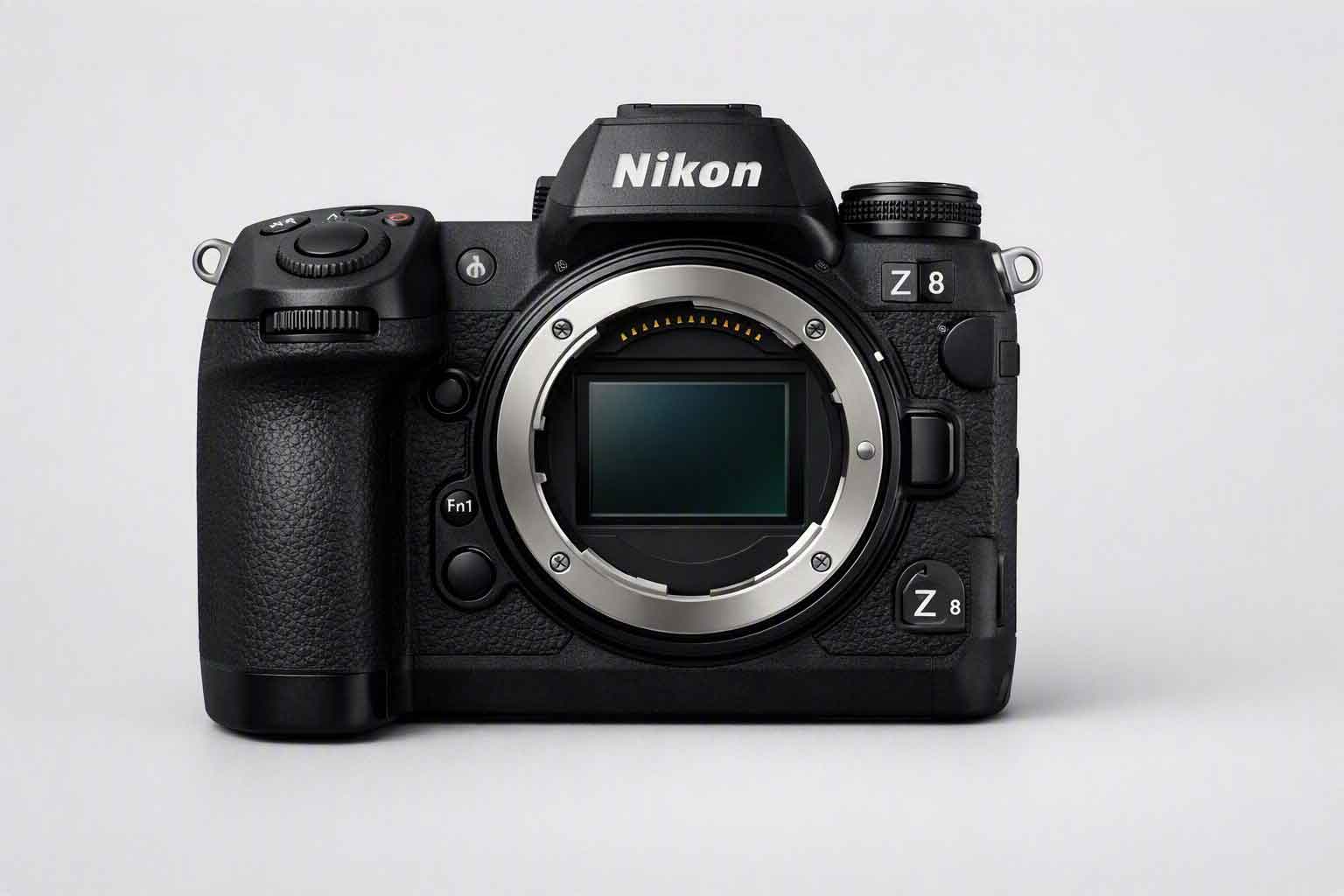
When Nikon launched the Z9 it reset expectations for what a professional mirrorless body could deliver. The Z8 takes that same 45.7-megapixel stacked BSI-CMOS sensor and EXPEED 7 processor, removes the integrated vertical grip, drops the price by roughly a third, and ships a camera that competes directly with Sony's Alpha 7 V and Canon's EOS R5 Mark II. The result is one of the strongest value propositions at the premium end of the mirrorless market — 8K internal RAW video, 20 fps RAW burst, and six-category subject detection, all in a weather-sealed magnesium body at $3,997.
Design & Ergonomics
The Z8 body is compact for a professional full-frame camera — 910 g without a grip, with a deep right-hand grip that locks the body securely during long telephoto sessions. Nikon's dual-dial ergonomic philosophy places a rear command dial and front sub-command dial within thumb and index-finger reach, making exposure adjustments intuitive without pulling the eye from the viewfinder. Weather sealing meets the same dust-and-drip standard as the Z9, using Nikon's proven magnesium-alloy chassis.
The 3.69M-dot OLED EVF offers 0.80× magnification and a wide blackout-free view during burst shooting — a meaningful advantage over EVFs that blank momentarily between frames. The 3.2-inch multi-angle tilting touchscreen accommodates most shooting orientations, though portrait-format work benefits from adding the MB-N12 grip with its additional controls.
Image Quality
The 45.7MP stacked BSI-CMOS sensor in the Z8 is the same unit fitted to the Z9, and it shows. Dynamic range is exceptional — particularly in the mid-tones and lower shadow regions where back-side illumination architecture reduces read noise — and resolving power through Nikon's Z-mount lenses (which have some of the widest throat diameters available) reveals a level of corner-to-corner sharpness that pushes the limits of the sensor itself.
High-ISO performance benefits from the EXPEED 7 processor's noise-reduction pipeline. ISO 6400 files retain impressive color fidelity and fine detail, and ISO 12800 is comfortably usable for editorial work. The stacked architecture also eliminates rolling shutter in electronic mode — a critical distinction from most 45MP sensors, which show significant skewing when panning.
Nikon's Picture Control system provides a refined set of JPEG interpretations, and the addition of N-Log and N-Raw formats ensures the Z8's imaging pipeline is equally at home in a video color-grading workflow as in a Lightroom-based stills edit.
Autofocus Performance
The Z8 runs the same autofocus firmware as the Z9, which means it benefits from every incremental improvement Nikon has pushed to that flagship over its production life. The 493-point phase-detect array covers the sensor broadly, and deep-learning subject recognition handles Human, Animal, Bird, Vehicle, Airplane, and Train categories with a confidence that matches — and in bird-in-flight testing, sometimes exceeds — Sony's equivalent system.
3D Tracking mode is particularly strong for erratically moving subjects: tennis players mid-serve, dogs at a full sprint, birds banking through complex backgrounds. The camera calculates subject trajectory and pre-positions AF before the subject reaches the predicted point. At 20 fps with no blackout, keepers-per-burst ratios are consistently high.
Video Capabilities
The Z8's video specification is frankly extraordinary for a $3,997 body. Internal 8K/30p recording in Nikon's RAW format — saved to CFexpress Type B cards — gives filmmakers a post-production resource that was previously available only in cameras costing significantly more. For delivery-standard work the 4K/120p no-crop mode (oversampled from the full sensor width) provides slow-motion footage with exceptional resolution and no moire.
N-Log covers the base color-science needs for professional grading, and ProRes RAW output over HDMI provides an Atomos Shogun-friendly workflow for editors working in Final Cut Pro. The 6-stop IBIS system handles moderate handheld movement, and Active VR adds electronic stabilization on top for run-and-gun scenarios. Unlimited recording time — inherited from the Z9's thermal engineering — means the Z8 does not require cooldown periods during extended interview or event video captures.
Pros & Cons
Pros
- 45.7MP stacked BSI sensor gives Z9-class performance without the Z9 price
- 20 fps RAW electronic burst with zero blackout and no rolling shutter artifacts
- 8K/30p RAW internal video is a remarkable feat at this price tier
- 4K/120p no crop delivers genuinely cinematic high-frame-rate footage
- Subject detection across six categories (Human, Animal, Bird, Vehicle, Airplane, Train)
- N-Log + ProRes RAW over HDMI covers professional video pipeline needs
- Dual CFexpress Type B slots handle the most demanding workflows
Cons
- Standard battery life (~340 shots) requires spares or grip for full-day shoots
- CFexpress Type B cards are large, expensive, and add system cost
- 910 g body weight is substantial — not a compact travel option
- No built-in grip means adding one increases size and total cost significantly
- Tilting (not fully articulating) LCD limits certain shooting angles
Full Specifications
| Sensor | 45.7 MP stacked BSI-CMOS, full-frame 35mm |
|---|---|
| Processor | EXPEED 7 |
| Autofocus Points | 493-point phase-detect |
| Subject Detection | Human, Animal, Bird, Vehicle, Airplane, Train |
| Burst Rate | 20 fps RAW (electronic) / 20 fps (mechanical) |
| Video | 8K/30p RAW internal; 4K/120p no crop; N-Log; ProRes RAW via HDMI |
| Stabilization | Up to 6-stop IBIS |
| ISO Range | 64–25600 (expandable 32–102400) |
| Viewfinder | 3.69M-dot OLED, 0.80× magnification |
| LCD | 3.2″ multi-angle tilting touchscreen, 2.1M dot |
| Battery Life | ~340 shots (CIPA) / ~1,340 with EN-EL18d grip |
| Card Slots | 2× CFexpress Type B + SD UHS-II combo |
| Connectivity | Wi-Fi, Bluetooth, USB-C (10Gbps), full-size HDMI, 3.5mm mic/headphone |
| Body Weight | 910 g (body only) |
| Weather Sealing | Yes — dust and drip resistant, magnesium alloy |
| Price (MSRP) | $3,997 body only |
Final Verdict
The Nikon Z8 delivers Z9 performance in a body that costs significantly less and weighs markedly less — a combination that makes it our top pick for photographers and filmmakers who want flagship specifications without the bulk or price of the full Z9 package. Internal 8K RAW video, 20 fps RAW stills, six-category subject detection, and extraordinary sensor performance place it among the two or three best full-frame mirrorless cameras currently available. Add a battery grip for all-day shoots and this camera does everything a working professional could ask.
Buy on Amazon — $3,997Affiliate link — see our disclosure.