Canon EOS R50 Review
Canon's best beginner mirrorless — compact, smart, and a genuine step up from a smartphone
Mirrorless · APS-C
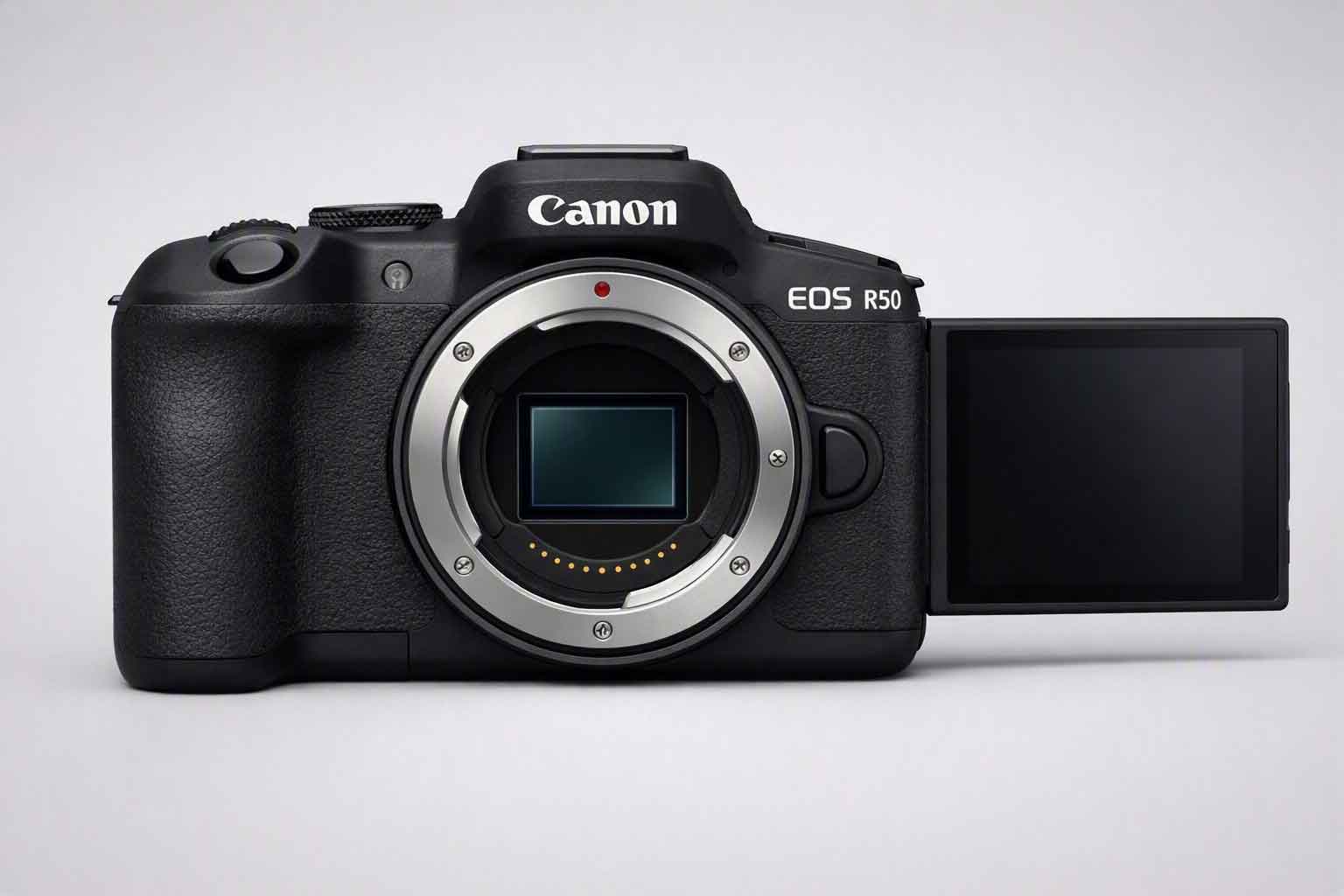
The Canon EOS R50 is designed for photographers who are ready to move beyond a smartphone but are not yet ready for the price or complexity of a more advanced mirrorless system. It delivers Canon's Dual Pixel CMOS AF II — the same subject-detection technology found in cameras costing three times as much — at $679, making sophisticated autofocus accessible to first-time camera buyers in a way that was simply not possible five years ago. The 24.2MP APS-C sensor, 4K/30p oversampled from 6K, 30fps electronic burst, and a fully articulating touchscreen round out a package that covers the fundamental needs of portrait, street, travel, and content creation photography without requiring any technical background.
The R50's limitations are predictable for its price tier: no IBIS, no weather sealing, no dual card slots, and a compact body that sacrifices some grip ergonomics for portability. These are the expected trade-offs at this price point. What distinguishes the R50 from its direct competitors — the Nikon Z50 II and Sony ZV-E10 — is the combination of Canon's class-leading DPAF II autofocus, the 4K/30p oversampled video quality, and the full RF mount ecosystem that gives growing photographers a clear upgrade path without changing systems. For a first camera, or for a travel companion to a larger primary body, the R50 is an excellent choice.
Design & Ergonomics
The R50's 375g body is one of the lightest in the RF lineup, and the compact dimensions make it genuinely pocketable with a pancake or slim prime lens attached. The grip is shallower than the R10 above it — a natural compromise for the compact form factor — but provides adequate purchase for short to medium shooting sessions. For extended handheld shooting, particularly with heavier RF-S zoom lenses, the grip depth becomes a more relevant consideration.
The fully articulating 3.0-inch touchscreen is the R50's most practically useful ergonomic feature. It flips all the way to face front for vlogging, angles down for low-angle shooting, and the touch-to-focus and touch-to-shoot implementation works reliably in both photo and video modes. The 2.36M-dot OLED EVF is a genuine differentiator at this price — many entry-level cameras ship without a viewfinder, and for bright outdoor shooting the EVF provides a significant practical advantage. The DIGIC X processor ensures responsive menu navigation and fast image review, making the user experience feel polished rather than entry-level.
Image Quality
The 24.2MP APS-C CMOS sensor produces excellent results in the ISO 100–1600 range — detail is high, color rendering is accurate and pleasing, and Canon's JPEG processing engine produces natural, well-balanced images straight from the camera without the artificial over-sharpening that some entry-level cameras apply. At ISO 3200–6400, luminance noise becomes progressively visible but remains manageable for social media and moderate print sizes. At ISO 12800 and above, noise reduction in-camera maintains usability at the expense of fine detail.
Portrait images benefit from the DPAF II eye detection even at the APS-C format's moderate subject isolation — RF-S lenses like the 18-45mm f/4.5-6.3 provide flattering compression at portrait distances, and Canon's skin tone rendering at base ISO is among the best in its class. RAW files via Canon's CR3 format provide good recovery headroom in highlights and shadows for photographers who develop their own files, and the Canon Digital Photo Professional app is available for free RAW processing specifically optimized for Canon sensor output.
Autofocus
The R50's 651-zone Dual Pixel CMOS AF II with Human, Animal, and Vehicle detection is its most compelling feature at this price point. Eye detection for human subjects locks immediately and tracks reliably through portrait distances with a precision that allows beginners to focus entirely on composition rather than technical focus concerns. Animal detection for pets and wildlife within reasonable subject distances functions correctly and is a practical asset for family photographers with pets.
At the 30fps electronic burst rate, the DPAF II system maintains subject tracking through moderate motion — walking subjects, children at play, casual sports — with a consistency that was not achievable at this price before Canon's current generation. For fast-paced sports and wildlife at distance, the R50's AF is less competitive than the R10's system, but for the primary use cases of its target audience, it is genuinely excellent. Video AF is smooth, natural, and well-suited to vlogging and interview formats, with face detection operating reliably in both front-facing and conventional shooting orientations.
Video Performance
The R50's 4K/30p video, oversampled from the full 6K sensor width, is the camera's most impressive specification relative to its price. The oversampling process — reading all sensor pixels and downsampling to 4K output — produces significantly more detail, color accuracy, and resolving sharpness than a pixel-binned or line-skipped 4K output. At 4K/30p, the R50 produces video quality that competes directly with cameras at $1,000 and above.
FHD/120p provides 5× slow-motion capability for highlight reels and insert shots. The fully articulating screen makes the R50 a natural fit for content creators and vloggers, and the face detection AF in video mode is reliable enough for solo operation without a dedicated camera operator. The absence of IBIS means walking shots require lens stabilization to be effective — the RF-S 18-45mm's OIS is adequate for stationary talking-head shots but noticeable at walking pace. For desk and tripod-based vlogging, the R50's video output is excellent.
Pros & Cons
Pros
- $679 brings Canon's Dual Pixel CMOS AF II with full subject detection to the most accessible entry point in the RF lineup
- 4K/30p oversampled from 6K produces video quality that rivals cameras at twice the price
- 30 fps electronic burst with DPAF II tracking handles fast-action and sports photography at entry level
- 375 g compact body is light enough to carry every day without fatigue or reluctance
- Fully articulating touchscreen supports vlogging, low-angle, and overhead shooting without a monitor
- 2.36M-dot OLED EVF provides a real optical viewfinder experience absent from many competing beginner cameras
- Full RF mount compatibility opens the entire Canon lens ecosystem including future telephoto and prime options
Cons
- No IBIS — stabilization relies entirely on lens IS, which varies significantly by lens
- Single SD UHS-II slot is adequate but provides no redundancy for critical shooting
- No weather sealing restricts confident use in rain, mist, or dusty field conditions
- FHD/120p crops the sensor — full-width only at 4K/30p and FHD/60p and lower frame rates
- At $679 without a lens, the kit lens cost significantly increases total entry price
- ~380 shot battery life requires a spare for full-day event shooting
Full Specifications
| Sensor | 24.2 MP APS-C CMOS |
|---|---|
| Processor | DIGIC X |
| Autofocus Points | 651-zone Dual Pixel CMOS AF II |
| Subject Detection | Human, Animal, Vehicle |
| Burst Rate | 30 fps (electronic) / 12 fps (mechanical) |
| Video | 4K/30p oversampled from 6K; FHD/120p |
| Stabilization | None (relies on lens IS) |
| ISO Range | 100–32000 (expandable 100–51200) |
| Viewfinder | 2.36M-dot OLED EVF, 0.59× (equiv.) magnification |
| LCD | 3.0″ fully articulating touchscreen, 1.04M dot |
| Battery Life | ~380 shots (CIPA) |
| Card Slots | 1× SD UHS-II |
| Connectivity | Wi-Fi, Bluetooth, USB-C, micro-HDMI |
| Body Weight | 375 g (body only) |
| Weather Sealing | None |
| Price (MSRP) | $679 body only |
Final Verdict
The Canon EOS R50 is the best beginner mirrorless camera for photographers and content creators starting their first interchangeable-lens journey in 2026. Canon's DPAF II autofocus system makes technically demanding photography — sharp portraits, moving subjects, fast action — accessible to users without prior camera experience. The 4K/30p oversampled video quality, fully articulating screen, and lightweight 375g body add practical utility for vloggers and everyday creators. The lack of IBIS and weather sealing are the primary operational constraints, but within the R50's intended use — casual photography, vlogging, family documentation, travel — these are rarely limiting. At $679, it represents Canon's most accessible path into serious photography.
Check Price on Amazon