Canon EOS R5 Mark II Review
Canon's stacked-sensor flagship redefines what a hybrid camera can do
Mirrorless · Full-Frame
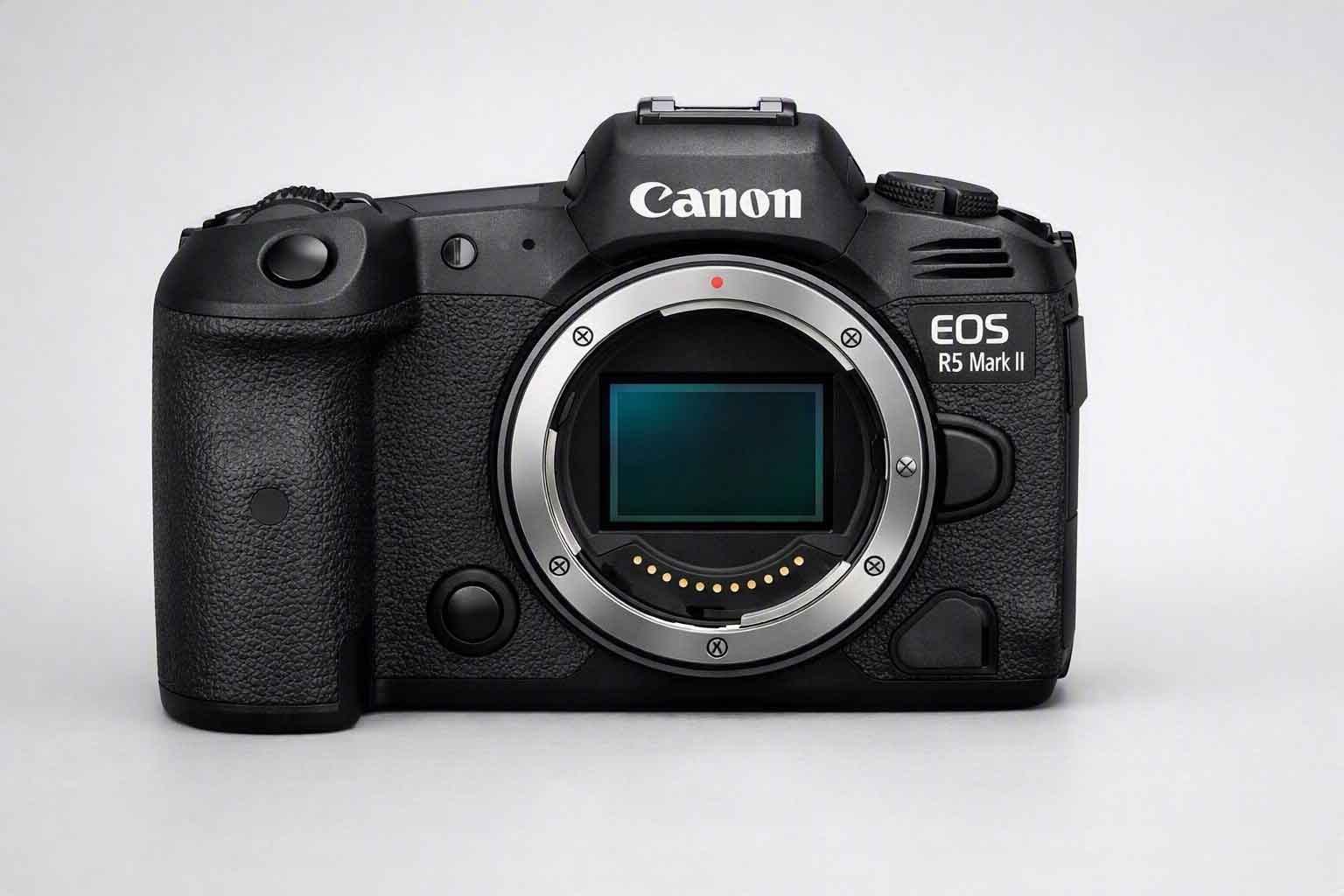
Canon's original EOS R5 introduced 8K video to a consumer mirrorless body and was immediately controversial — heat throttling, battery drain, and the practical limits of shooting uncompressed 8K made it more aspirational than operational for many users. The R5 Mark II fixes every one of those problems. A 45-megapixel stacked BSI-CMOS sensor eliminates rolling shutter, a dedicated AI Accelerator chip runs DPAF III subject recognition without stealing resources from image processing, and an active cooling fan enables unlimited 8K/60p RAW recording. This is the camera the original R5 was trying to be.
Design & Ergonomics
The R5 Mark II body is slightly larger than its predecessor to accommodate the active cooling system, landing at 746 g — heavy for mirrorless but well-balanced with Canon's RF L-series lenses. The grip is deep, the rubberized surfaces are secure, and the button placement follows Canon's RF ergonomic logic with dedicated AF-On, M-Fn bar, and a joystick for AF point selection. The 5.76M-dot OLED viewfinder matches the X-T5's panel for sheer resolution and exceeds it in magnification at 0.76×.
The 4.15M-dot fully articulating LCD is the highest-resolution rear screen in any Canon mirrorless and the sharpest articulating display in any full-frame body as of this review. It handles fine-detail manual focus confirmation at 100% zoom with exceptional fidelity. Weather sealing is thorough, using Canon's proven gasket system at every joint, button, and dial.
Image Quality
Forty-five megapixels from a stacked full-frame BSI-CMOS sensor is an extraordinary starting point. The stacked architecture accelerates readout speed to the point where rolling shutter is essentially eliminated — panning shots and fast electronic bursts that would show skewing on non-stacked sensors look clean and undistorted. Dynamic range is broad at base ISO, with shadow recovery extending approximately three stops before luminance noise becomes significant.
Canon's color science in the R5 Mark II is warm and flattering — particularly for skin tones and natural environments — and the expanded Canon Log 3 dynamic range profile captures approximately 14 stops of scene latitude for grading. High-ISO performance is excellent: ISO 6400 files retain strong color accuracy, and ISO 12800 is editorial-ready for web and broadcast delivery. At native ISO, the 45MP sensor provides detail resolution competitive with medium-format sensors at a fraction of the system cost.
Autofocus Performance
Canon's Dual Pixel CMOS AF III in the R5 Mark II is among the finest autofocus systems ever placed in a camera body. The dedicated AI Accelerator chip processes subject recognition simultaneously with — not instead of — image processing, meaning the 30 fps electronic burst does not slow AF calculation during fast action. Subject categories cover Human (with face, eye, head, and body tracking options), Animal, Vehicle, and Aircraft.
Real-world tracking is exceptional. Eye tracking holds through rapid head turns, partial occlusion, and subjects crossing light-to-shadow transitions. Vehicle tracking holds through fast-moving motorsport scenarios where background elements and subject merge momentarily. At 30 fps with a CFexpress Type B card, the buffer runs deep enough for extended bursts without interruption. The R5 Mark II's AF is not merely improved from the original — it represents a genuine generational leap.
Video Capabilities
The R5 Mark II's video specification is the most complete ever offered in a Canon mirrorless body. Internal 8K/60p in Cinema RAW Light format captures at approximately 2.6 Gbps — a data rate that requires CFexpress Type B media and a capable editing workstation, but produces footage with extraordinary post-production flexibility. The 4K/120p no-crop mode is the headline for working hybrid shooters: full-sensor 4K slow motion at 120 fps with no field of view penalty, oversampled from a 5.5K readout for exceptional sharpness.
The active cooling fan runs near-silently during outdoor shooting and is audible only in very quiet indoor environments — a small trade-off for the ability to record unlimited 8K without thermal interruptions. Canon Log 3 and C-Log2 options cover both broadcast and cinema grading workflows, and the 8.5-stop IBIS system — one of the best in any full-frame body — handles run-and-gun documentary and event video with remarkable stability.
Pros & Cons
Pros
- 8K/60p RAW internal recording was previously reserved for cinema cameras costing far more
- 4K/120p no-crop delivers flawless slow-motion from the full sensor width
- DPAF III with AI Accelerator is Canon's most responsive subject-tracking system ever
- 45MP stacked sensor eliminates rolling shutter — crucial for sports and action
- 5.76M-dot OLED viewfinder + 4.15M-dot articulating LCD: best screens in any Canon body
- 8.5-stop IBIS coordinated with IS lenses produces gimbal-smooth handheld footage
- Active cooling fan enables unlimited 8K recording without thermal interruption
Cons
- $4,299 body-only is a serious financial commitment
- CFexpress Type B card requirement adds meaningful accessory cost
- 8K/60p RAW files are enormous — storage and editing workstation demands are very high
- Active cooling fan adds a faint noise audible in quiet interview environments
- 746 g body is substantial — not ideal for minimalist travel kit
Full Specifications
| Sensor | 45 MP stacked BSI-CMOS, full-frame 35mm |
|---|---|
| Processor | DIGIC X III + dedicated AI Accelerator chip |
| Autofocus Points | 1,053-zone Dual Pixel CMOS AF III |
| Subject Detection | Human, Animal, Vehicle, Aircraft |
| Burst Rate | 30 fps (electronic) / 12 fps (mechanical) |
| Video | 8K/60p RAW internal; 4K/120p no crop; FHD/240p |
| Stabilization | Up to 8.5-stop IBIS (coordinated IS lenses) |
| ISO Range | 100–51200 (expandable 50–102400) |
| Viewfinder | 5.76M-dot OLED, 0.76× magnification |
| LCD | 3.2″ fully articulating touchscreen, 4.15M dot |
| Battery Life | ~490 shots (CIPA) |
| Card Slots | 1× CFexpress Type B + 1× SD UHS-II |
| Connectivity | Wi-Fi 6, Bluetooth 5.3, USB-C (10Gbps), full-size HDMI |
| Body Weight | 746 g (body only) |
| Cooling | Active cooling fan (sustained 8K recording) |
| Weather Sealing | Yes — dust and moisture resistant |
| Price (MSRP) | $4,299 body only |
Final Verdict
The Canon EOS R5 Mark II is the best hybrid camera Canon has ever made — and a serious contender for the best hybrid mirrorless available from any manufacturer. It resolves the original R5's heat limitations with an active cooling system, eliminates rolling shutter with a stacked sensor, elevates subject tracking with a dedicated AI chip, and delivers 8K/60p RAW internal video from a body that weighs under 750 g. At $4,299 it demands a significant investment — but for photographers and cinematographers who need a single body to handle every professional assignment, the R5 Mark II earns its Editors' Choice rating without reservation.
Buy on Amazon — $4,299Affiliate link — see our disclosure.