Nikon Z30 Review
Nikon's creator-focused APS-C — no viewfinder, no distractions, pure content
Mirrorless · APS-C Vlog
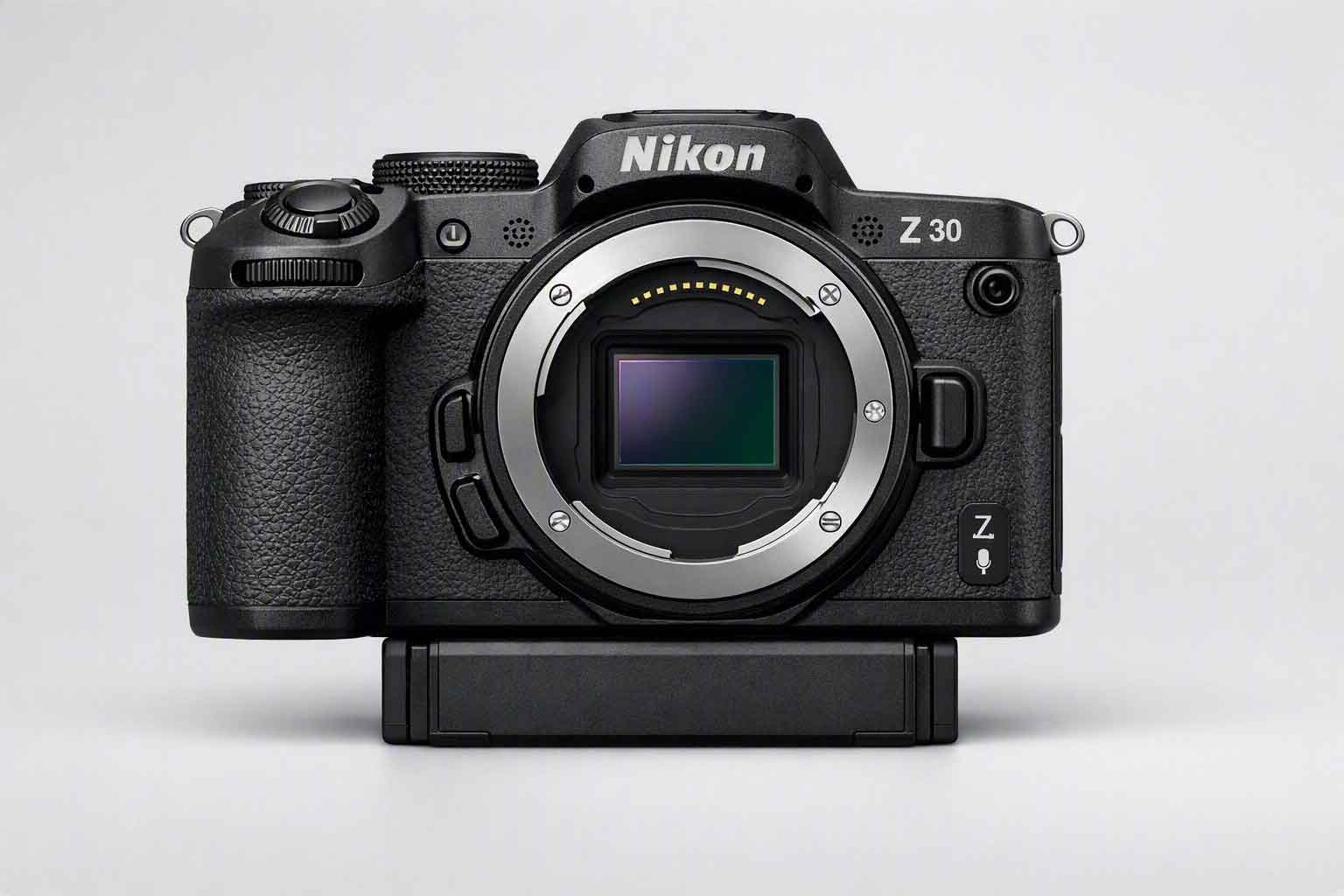
Nikon designed the Z30 with a clear brief: build a Z-mount APS-C camera specifically for content creators and vloggers, strip away the features that creators don't need — the EVF, the traditional control hierarchy — and invest those savings in creator-specific assets like a built-in stereo microphone, a 3.5mm external mic jack, a vari-angle LCD, and N-Log via HDMI output. The result is a 405g camera at $599 that gives content creators direct access to Nikon's Z-mount lens ecosystem — including exceptional prime lenses — with phase-detect AF, 4K/30p video, and professional log output, at a price that's genuinely accessible.
Comparing the Z30 to the Sony ZV-E10 — its most direct competitor — reveals that Nikon has made thoughtful choices on both sides of the trade-off ledger. The Z30's EXPEED 6 processor is a generation older than ideal, and 4K is limited to 30fps. But the 10-bit N-Log HDMI output, the expandable ISO to 204800, the 30fps pre-burst electronic shutter, and the BSI-CMOS sensor's daylight performance are genuine assets. For Nikon shooters who already own Z-mount lenses, the Z30 makes even more sense — it adds a compact, affordable second body without any system switching cost.
Design & Ergonomics
The Z30 prioritizes compactness and creator-oriented layout. The absence of an EVF makes the body significantly more compact than the Z50 II above it, and the weight savings at 405g are meaningful for daily carry. The deep, well-shaped grip is the Z30's best ergonomic feature — it accommodates a secure hold for both photo and one-handed video shooting, and the grip depth provides better purchase than the shallower Z50 and ZV-E10 bodies.
The flip-down vari-angle LCD can rotate in multiple positions: flat against the body for transport, flipped down for low-angle shooting, and rotated to face forward for self-facing vlogging. In the forward position, the 3.0-inch panel fills the creator's frame view adequately at 1.04M dots — the resolution is sufficient for framing and focus confirmation, if not as crisp as the Z50 II's implementation. The built-in stereo microphone array is mounted above the lens mount and captures significantly better audio than typical single-capsule camera microphones. The 3.5mm mic jack accepts standard directional microphones, lavaliers, and wireless receiver outputs.
Image Quality
The 20.9MP BSI-CMOS sensor produces strong results in the ISO 100–3200 range. At base ISO, 4K/30p video is clean and well-resolved, and Nikon's color science in Picture Control produces natural, film-like tones that are immediately pleasing without heavy post-processing. The BSI architecture provides better light-gathering efficiency than conventional CMOS sensors, which translates to cleaner output at moderate ISOs — a meaningful advantage for indoor available-light vlogging.
At ISO 6400–12800, luminance noise is present but manageable for social media delivery. N-Log via HDMI output — recording 10-bit log to an external recorder — provides a significant quality step up, capturing more dynamic range and providing substantially more grading latitude than the internal 8-bit recording. For creators who invest in an Atomos Ninja or similar external recorder, the Z30 punches well above its sensor class in color quality. Still photography RAW files via NRW format provide solid recovery headroom and feed cleanly into Lightroom and Capture One.
Autofocus
The Z30's phase-detect AF system with Human, Dog, and Cat subject detection performs reliably for the camera's primary use cases. Face and eye detection for human subjects is accurate in portrait-distance vlogging, and the system maintains tracking through natural head movement, looking to the side, and reasonable subject-to-camera distance changes. Dog and Cat detection adds useful pet tracking that family creators and pet channel operators will find genuinely practical.
For faster action — running subjects, sports, birds in flight — the Z30's AF system is less competitive than the EXPEED 7-based Z50 II or Sony's BIONZ XR system in the A6700 and ZV-E10. The EXPEED 6 processor's subject tracking depth is adequate rather than exceptional for fast motion. For the stationary and slow-paced shooting that defines most vlogging, content creation, street photography, and casual portraiture, the Z30's AF is fully adequate and reliably confident.
Video Performance
The Z30's 4K/30p internal video is clean and detailed in good light, and the DX-format sensor produces a flattering crop that works well with standard kit and prime focal lengths. FHD/120p provides smooth 5× slow-motion for highlight reels and insert sequences. The electronic VR (vibration reduction) mode applies digital stabilization in video, adding a stabilized look to static or near-static shots — for walking video, the result is noticeably less effective than optical or sensor-shift systems.
The 10-bit N-Log HDMI output is the Z30's most significant professional video asset. Paired with a compatible external recorder, the Z30 records cinema-grade log footage with dynamic range and color depth that its internal recording cannot match. For creators who are building their production setup incrementally — starting with the Z30 body and adding an external recorder when the budget allows — this represents a genuine, usable upgrade path rather than a marketing checkbox. The full-size micro-HDMI port accepts standard cables without an adapter.
Pros & Cons
Pros
- EXPEED 6 processor delivers reliable phase-detect AF with Human, Dog, and Cat subject detection at $599
- 10-bit N-Log via HDMI output provides professional-grade log recording for color work
- Built-in stereo microphone plus 3.5mm external mic jack covers both convenience and quality audio needs
- 30 fps pre-burst electronic shutter captures the moment before full press — useful for decisive moment photography
- 405 g compact Z-mount body gives access to Nikon's full lens ecosystem including superb primes
- Flip-down vari-angle LCD supports a wide range of self-facing and low-angle shooting positions
- ISO expandable to 204800 for extreme low-light shooting scenarios
Cons
- No IBIS — electronic VR only, which applies a crop and cannot match optical stabilization for handheld video
- ~330 shot battery life is below average; carry a spare or use USB-C power bank during shoots
- EXPEED 6 is a previous-generation processor compared to the EXPEED 7 in the Z50 II at a similar price
- UHS-I card slot limits burst buffer performance and video data rate headroom
- No weather sealing for outdoor or field use in unpredictable conditions
- 4K/30p with DX crop — no 4K/60p and no full-width 4K mode available on the Z30
Full Specifications
| Sensor | 20.9 MP APS-C BSI-CMOS |
|---|---|
| Processor | EXPEED 6 |
| Autofocus Points | Phase-detect AF with subject detection |
| Subject Detection | Human, Dog, Cat |
| Burst Rate | 11 fps (mechanical) / 30 fps (pre-burst electronic) |
| Video | 4K/30p; FHD/120p; 10-bit N-Log via HDMI |
| Stabilization | Electronic VR (no IBIS) |
| ISO Range | 100–51200 (expandable 100–204800) |
| Viewfinder | None |
| LCD | 3.0″ flip-down vari-angle touchscreen, 1.04M dot |
| Battery Life | ~330 shots (CIPA) |
| Card Slots | 1× SD UHS-I |
| Connectivity | Wi-Fi, Bluetooth, USB-C, micro-HDMI |
| Microphone | Built-in stereo + 3.5mm mic jack |
| Body Weight | 405 g (body only) |
| Weather Sealing | None |
| Price (MSRP) | $599 body only |
Final Verdict
The Nikon Z30 is the right camera for a specific creator: someone who wants Z-mount APS-C image quality, built-in stereo audio, an external mic jack, N-Log HDMI output, and Nikon's reliable AF — all in a compact 405g body at $599. The EXPEED 6 processor, absence of 4K/60p, and UHS-I card slot are the primary constraints that separate it from the more capable Z50 II at a slightly higher price. For new creators entering the Nikon ecosystem, and for Nikon photographers adding a compact second body for content work, the Z30 offers genuine utility at an accessible price. At $599 it faces stiff competition from the Sony ZV-E10, but its HDMI N-Log output and ergonomic grip give it distinct advantages for creators with an external recording workflow.
Check Price on Amazon