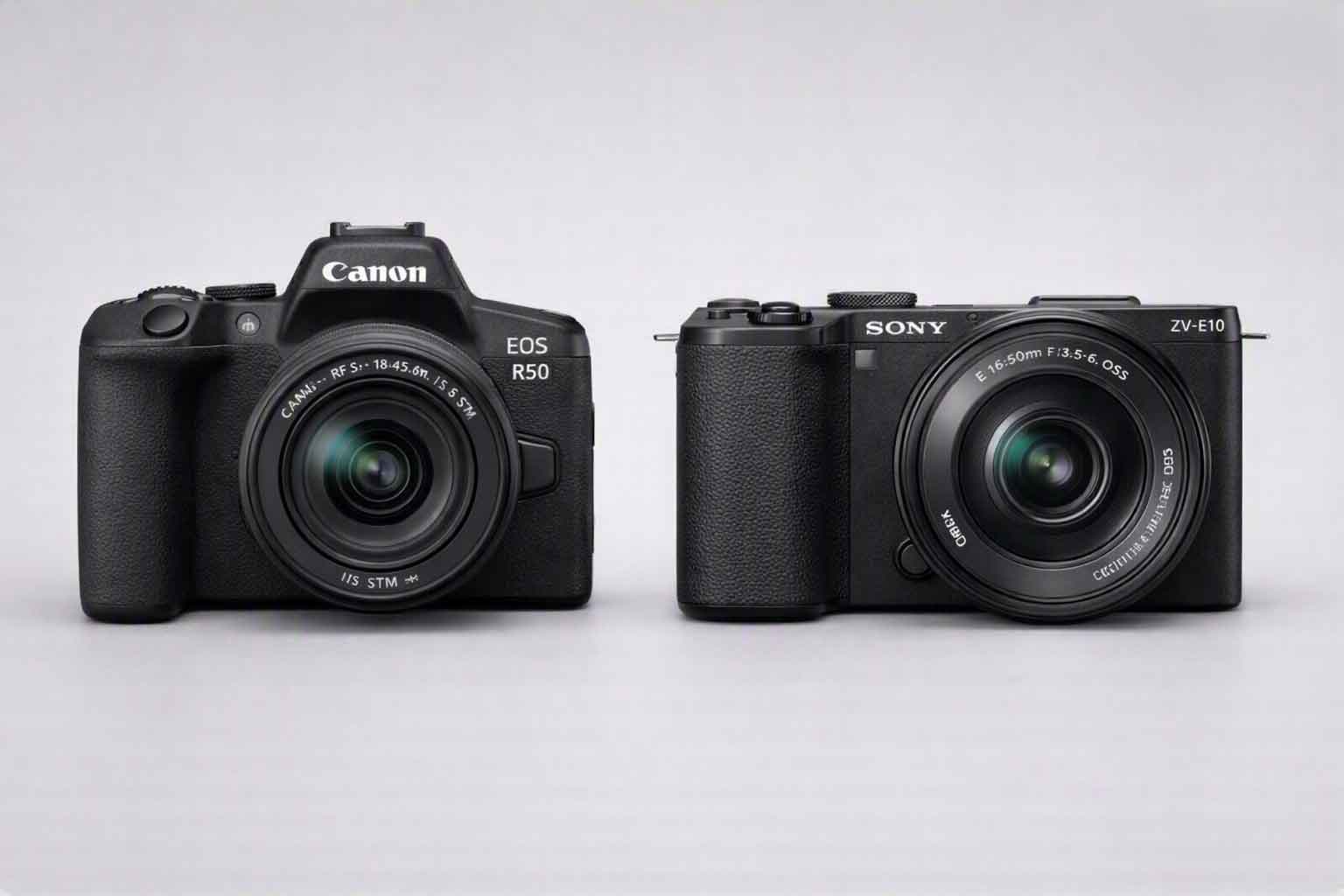
Specs at a Glance
| Specification | Canon EOS R50 | Sony ZV-E10 |
|---|---|---|
| Megapixels | 24.2 MP | 24.2 MP |
| Sensor Type | APS-C CMOS | APS-C Exmor CMOS |
| Autofocus Points | 651-zone DPAF II | 425-point PDAF |
| Subject Detection | Human, Animal, Vehicle | Human, Animal |
| Burst Rate | 30 fps (electronic) | 11 fps |
| Max Video | 4K/30p (from 6K) | 4K/30p; S-Log3 |
| IBIS | None | None |
| Built-in Mic | Stereo | 3-capsule directional stereo |
| LCD | Fully articulating touch | Side-flip vari-angle touch |
| Battery Life | ~380 shots | ~440 shots |
| Body Weight | 375 g | 343 g |
| Weather Sealing | No | No |
| Price (MSRP) | $679 | $599 |
Introduction
The Canon EOS R50 and Sony ZV-E10 are two of the most accessible APS-C interchangeable lens cameras on the market — both priced under $700, both targeting first-time mirrorless buyers and content creators who want better quality than a smartphone delivers. They share a 24.2MP sensor resolution, an absence of weather sealing and IBIS, and a compact form factor that makes them easy to carry anywhere.
Where they diverge is in their primary design philosophy. The R50 is built around Canon's DPAF II autofocus system — giving it AF capabilities that rival cameras costing twice as much — paired with a fully articulating LCD and Canon's straightforward menu system. The ZV-E10 is Sony's creator-first camera: a 3-capsule directional microphone, side-flip LCD optimized for face-to-camera vlogging, S-Log3 for color grading, and access to the world's largest mirrorless lens catalog via E-mount — all at $80 less.
Design & Ergonomics
The Canon EOS R50 at 375 g is light and compact with a grip that feels secure for one-handed operation with a kit lens. The fully articulating LCD rotates to face forward — critical for self-facing video and vlogging — and the touchscreen navigation is intuitive enough for users coming from smartphones. Canon's guided shooting modes and beginner-friendly menu hierarchy reduce the learning curve significantly.
The Sony ZV-E10 at 343 g is the lighter camera, with a side-flip LCD that swings out and rotates forward for vlogging. The side-flip hinge is slightly less flexible than Canon's fully articulating design — it cannot tilt down toward your feet for low-angle shooting — but it works well for the front-facing vlog use case the camera is designed for. The 3-capsule directional microphone is the standout physical feature: it actively focuses the audio pickup in the direction the camera is pointed, reducing background noise and side-rejection in real-world shooting environments.
Image Quality
Both cameras use 24.2MP APS-C sensors, and both produce images that are a significant step above smartphone quality in dynamic range, color depth, and low-light performance. Canon's sensor benefits from DPAF II integration — the autofocus information is extracted directly from every pixel, which also means exposure metering is tightly linked to subject detection. Canon's JPEGs with the Portrait Picture Style render skin tones cleanly and warmly, making them easy to share without post-processing.
Sony's Exmor CMOS sensor in the ZV-E10 is a proven APS-C chip that delivers excellent color accuracy and good dynamic range at base ISO. The availability of S-Log3 is the key differentiator for image quality users: it provides roughly 14 stops of dynamic range capture in a flat log profile that enables significant highlight and shadow recovery in post. For photographers and videographers who edit their footage, S-Log3 delivers more post-production flexibility than the Canon's JPEG-oriented pipeline.
Winner: Canon EOS R50 for straight-out-of-camera stills quality. Sony ZV-E10 for RAW video flexibility with S-Log3.
Autofocus
The Canon EOS R50's DPAF II system is a standout feature at this price. The 651-zone full-frame coverage with human, animal, and vehicle subject detection delivers autofocus performance that belongs in a camera costing $1,200 or more. Eye AF locks instantly on human subjects and stays locked through moderate motion and partial occlusion. For family photography, pet portraits, and casual sports, the R50's AF is genuinely exceptional and far ahead of the competition at its price.
The Sony ZV-E10's 425-point PDAF system performs adequately for portrait and vlog work — it tracks faces reliably in good light and holds focus during talking-head video. Where it falls behind the Canon is in fast subject tracking: the R50's DPAF II coverage density and Canon's tracking algorithm maintain lock more reliably on moving children, pets, and cyclists. For video creators who shoot themselves talking to camera, the AF difference is negligible. For action or wildlife work, Canon's advantage is pronounced.
Winner: Canon EOS R50. DPAF II is best-in-class at this price — it's not close.
Video
Both cameras record 4K/30p — the Canon from a 6K oversampled capture, the Sony from a pixel-binned readout. The Canon's oversampled 4K is sharper, with better fine detail retention. The Sony's pixel-binned 4K is softer but still serviceable for social media and online delivery at standard resolutions.
The Sony ZV-E10's decisive video advantage is S-Log3. At ISO 800 and above, S-Log3 captures a flat, high-latitude log image that, when graded, can render scenes with significant contrast — a sunset, a brightly lit window, a dark indoor environment — with more retained detail in both shadows and highlights than the Canon's standard picture styles allow. For creators who want a "cinematic look" and are willing to learn basic color grading, the ZV-E10 is the more capable video tool at this price. The Canon EOS R50 does not offer a log profile.
FHD slow-motion at 120p is available on both cameras. Neither has IBIS — for stable handheld video, a gimbal is recommended for both.
Winner: Tie. Canon wins on 4K sharpness; Sony wins on S-Log3 dynamic range and log workflow.
Battery Life
The Sony ZV-E10 rates at approximately 440 shots per charge, which is better than the Canon R50's approximately 380 shots. In real-world video use — where both cameras consume more power than stills — neither battery lasts a full day of heavy shooting without a spare or USB-C power delivery from a power bank. Both cameras support USB-C charging, making power banks an effective supplement for both.
Winner: Sony ZV-E10 by a modest margin.
Lens Ecosystems
Sony's E-mount is the most comprehensive mirrorless lens ecosystem available at any price. APS-C shooters benefit from a wide range of dedicated APS-C E-mount lenses from Sony (like the 10-20mm f/4 G PZ power zoom, ideal for vlogging), plus access to the full-frame E-mount catalog. Viltrox's AF prime lineup — 23mm, 35mm, and 56mm f/1.8 — provides fast, affordable primes that dramatically improve low-light and background separation over the kit lens at modest prices.
Canon's RF-S ecosystem is newer and smaller, but growing with purpose-built APS-C lenses including an 18-45mm and 18-150mm kit zoom range and the affordable RF 16mm f/2.8 STM prime. All full-frame RF lenses work natively on the R50, but the RF-S native selection is more limited for APS-C-specific needs than E-mount's dedicated lineup.
Winner: Sony ZV-E10. E-mount's depth and breadth at every price point gives it a clear advantage for entry-level buyers building their first kit.
Value
At $599, the Sony ZV-E10 is $80 cheaper than the Canon R50, and its E-mount ecosystem means the most affordable lenses — Viltrox primes, Tamron wide zooms — are also available to you. For budget-conscious creators, the ZV-E10's lower price of entry plus the breadth of affordable E-mount glass makes it the lower-cost path to a capable kit.
The Canon R50 at $679 delivers better autofocus and oversampled 4K for an $80 premium. For photographers who value stills quality and AF above all else, that premium is reasonable.
Winner: Sony ZV-E10 on overall value, particularly when accounting for lens ecosystem costs.
Final Verdict
The Canon EOS R50 wins this comparison on the strength of its DPAF II autofocus system and oversampled 4K image quality. For photographers — especially families capturing children, pets, and spontaneous moments — the R50's superior AF performance is the deciding factor. Nothing at this price tracks a moving subject as reliably.
The Sony ZV-E10 is the better choice for creators whose primary output is video content for YouTube, social media, or vlogs. The 3-capsule directional mic, side-flip LCD, S-Log3 support, and the E-mount ecosystem's breadth of affordable glass make it the more complete package for solo video production at the lowest price point. At $599, it remains one of the best value ILCs for content creators.
Choose the Canon EOS R50 if: DPAF II autofocus, oversampled 4K, and stills-first performance justify the $80 premium. Choose the Sony ZV-E10 if: vlogging features, S-Log3, E-mount lens variety, and a lower price define your priorities.