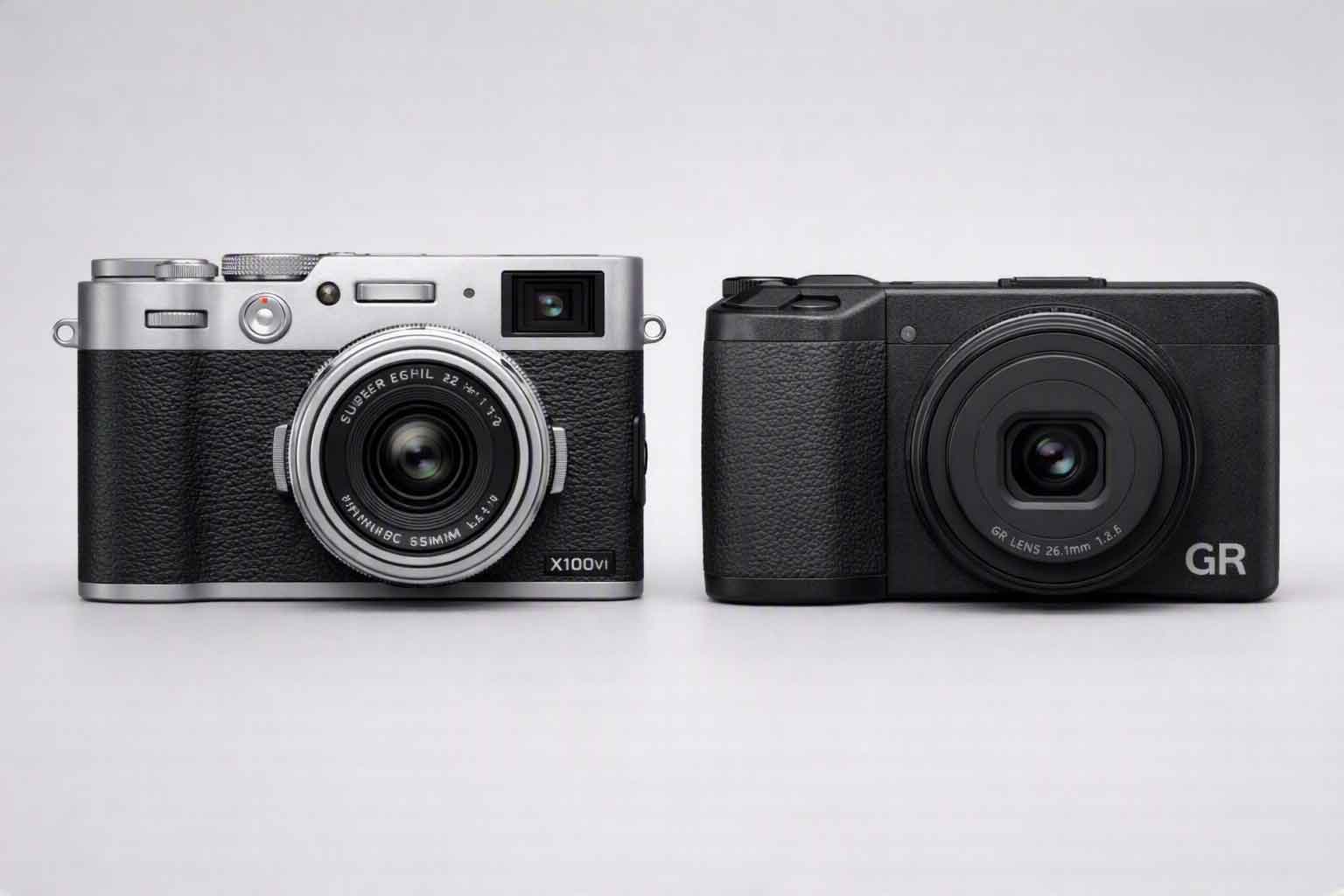
Specs at a Glance
| Specification | Fujifilm X100VI | Ricoh GR IIIx |
|---|---|---|
| Megapixels | 40.2 MP | 24.2 MP |
| Sensor Type | APS-C X-Trans 5 HR | APS-C CMOS (no LPF) |
| Focal Length | 23mm f/2 (35mm equiv.) | 40mm f/2.8 (equiv.) |
| Autofocus | 425-point hybrid PDAF | Contrast-detect + Snap Focus |
| Max Video | 6.2K/30p | FHD/60p only |
| Stabilization | 6-stop IBIS | 4-axis SR (no IBIS) |
| Viewfinder | Hybrid OVF/EVF | None |
| Built-in ND Filter | Yes (up to 4 stops) | No |
| Weather Sealing | Yes (56-point) | No |
| Battery Life | ~450 shots | ~200 shots |
| Body Weight | 521 g | 262 g |
| Price (MSRP) | $1,599 | $999 |
Introduction
These two cameras define opposite ends of the premium fixed-lens compact spectrum. The Fujifilm X100VI is the definitive APS-C compact: 40.2MP X-Trans resolution, a hybrid optical/electronic viewfinder, 6-stop IBIS, weather sealing, built-in ND filter, and 6.2K video capability — all wrapped in a classic rangefinder-styled body. The Ricoh GR IIIx is its antithesis: minimalist, 262 g, pocketable in a jacket, with a sharp 40mm f/2.8 lens and a focus on pure image quality and discreet capture over feature sets.
The $600 price gap — $1,599 for the X100VI versus $999 for the GR IIIx — is substantial. But so is the feature gap. The real question isn't which camera is more capable; it's which camera philosophy matches how you actually work.
Design & Ergonomics
The Fujifilm X100VI is a camera you carry because you want to be seen carrying it — and because it does everything. The hybrid OVF/EVF gives you both the optical clarity of a rangefinder finder and the exposure-preview accuracy of an electronic viewfinder, switchable with a lever. Weather sealing means you don't worry about rain. The built-in ND filter means you can shoot at f/2 in bright light without an add-on filter. The 521 g body fits in a large jacket pocket or a small bag.
The Ricoh GR IIIx is a camera that disappears into a shirt pocket. At 262 g, it is genuinely pocketable — the kind of camera that changes your shooting behavior because the barrier to having it with you is essentially zero. There is no viewfinder, no IBIS that can compare to the X100VI's six stops, and the contrast-detect autofocus is slower than the Fujifilm's PDAF system. But none of that matters if the camera is always with you.
Image Quality
The Fujifilm X100VI's 40.2MP X-Trans 5 HR sensor is the same chip found in the X-T5 and X-H2 — one of the highest-resolution APS-C sensors ever made. The 23mm f/2 lens is a Fujifilm optical benchmark: sharp center-to-corner wide open, with beautiful out-of-focus rendering and negligible distortion. Film Simulations — Velvia, Classic Chrome, Nostalgic Neg, Reala Ace — produce JPEGs so good that many photographers use them as final files without any post-processing.
The Ricoh GR IIIx's 24.2MP sensor without a low-pass filter produces extraordinarily sharp images from its 40mm f/2.8 lens. The combination of no LPF and the GR optics' resolving power means 1:1 crops at 100% show detail that approaches medium format in perceived sharpness per pixel. GR images have a distinct rendering character — slightly more clinical than Fujifilm's warmer palette — that dedicated GR users consider part of the camera's appeal rather than a limitation.
Winner: Fujifilm X100VI. 40.2MP X-Trans, Film Simulations, and a faster f/2 aperture give it a definitive stills advantage.
Autofocus
The X100VI's 425-point hybrid phase-detect AF system — shared with the X-T5 — performs well for a fixed-lens compact. Face and eye detection are reliable, and subject tracking works competently in moderate action. For street and travel work, the X100VI's AF is fast enough that missed shots due to focus failure are rare.
The Ricoh GR IIIx's contrast-detect autofocus is slower and struggles with fast-moving subjects in low light. In good light, it acquires focus adequately for street and documentary work. The Snap Focus and full manual focus modes partially compensate by bypassing AF entirely — skilled GR users often prefer these modes anyway.
Winner: Fujifilm X100VI by a significant margin in conventional autofocus performance.
Video
The Fujifilm X100VI records up to 6.2K/30p, 4K/60p, and FHD/120p with F-Log2 support. For a fixed-lens compact, this is an extraordinary video specification. The 6-stop IBIS keeps handheld footage stable, and the built-in ND filter lets you maintain proper shutter angle in bright conditions without a filter adapter. If you want to shoot video on a compact camera, the X100VI is the most capable tool in this class.
The Ricoh GR IIIx records Full HD at up to 60p only. There is no 4K mode. For photographers who never shoot video, this limitation is irrelevant; for hybrid creators, it's a hard stop.
Winner: Fujifilm X100VI by a wide margin. The GR IIIx is not a video camera.
Portability
The Ricoh GR IIIx weighs 262 g — roughly half the X100VI's 521 g. It fits in a shirt pocket. It has no protruding viewfinder housing. It disappears into a jacket so completely that you can carry it all day without awareness of its presence. For photographers whose primary challenge is having a quality camera available at unplanned moments, no camera in APS-C resolves that challenge as effectively as the GR IIIx.
Winner: Ricoh GR IIIx. Nothing in APS-C pockets as completely.
Focal Length Considerations
The X100VI's 23mm f/2 (35mm equivalent) is the most versatile focal length for a fixed-lens camera: wide enough for environmental portraiture and architectural context, tight enough for street candids at moderate distances. The f/2 maximum aperture delivers meaningful background separation at close focus distances.
The GR IIIx's 40mm f/2.8 (equivalent) is more of a specialist focal length — a natural perspective lens that produces less distortion and a more "normal" perspective than 35mm. Many photographers prefer 40mm over 35mm for its rendering quality, but f/2.8 gives you one stop less light and slightly less background blur than the X100VI's f/2.
Winner: Ricoh GR IIIx for photographers who prefer the natural rendering of 40mm. X100VI for those who need f/2 light-gathering and greater versatility.
Value
At $999, the Ricoh GR IIIx delivers exceptional image quality per dollar for a photographer-first tool. It does fewer things than the X100VI, but what it does — produce sharp, characterful APS-C images in the world's most pocketable package — it does better than anything at close to its price.
The X100VI at $1,599 justifies its price with a feature list no competitor matches: 40MP resolution, 6-stop IBIS, 6.2K video, built-in ND, weather sealing, and the hybrid finder. For the photographer who wants maximum capability in a compact, the premium is reasonable.
Winner: Ricoh GR IIIx on pure value per dollar. X100VI on feature value.
Final Verdict
The Fujifilm X100VI is the better camera by nearly every measurable metric — resolution, autofocus, video, stabilization, versatility, and build quality all favor Fujifilm. For photographers who want the best-equipped premium compact available, it is the clear recommendation.
The Ricoh GR IIIx is the better camera for the photographer who values minimalism, pocket-ability, and the specific rendering character of its unfiltered 24MP sensor. Its devotees are among the most loyal camera users in the industry — and that loyalty is earned. If you live by the principle that the best camera is the one you always have with you, the GR IIIx's shirt-pocket form factor makes it the camera you'll always have with you.
Choose the Fujifilm X100VI if: maximum resolution, weather sealing, IBIS, video, and versatility are your priorities. Choose the Ricoh GR IIIx if: ultimate portability, 40mm rendering, and a minimalist shooting philosophy define how you work.