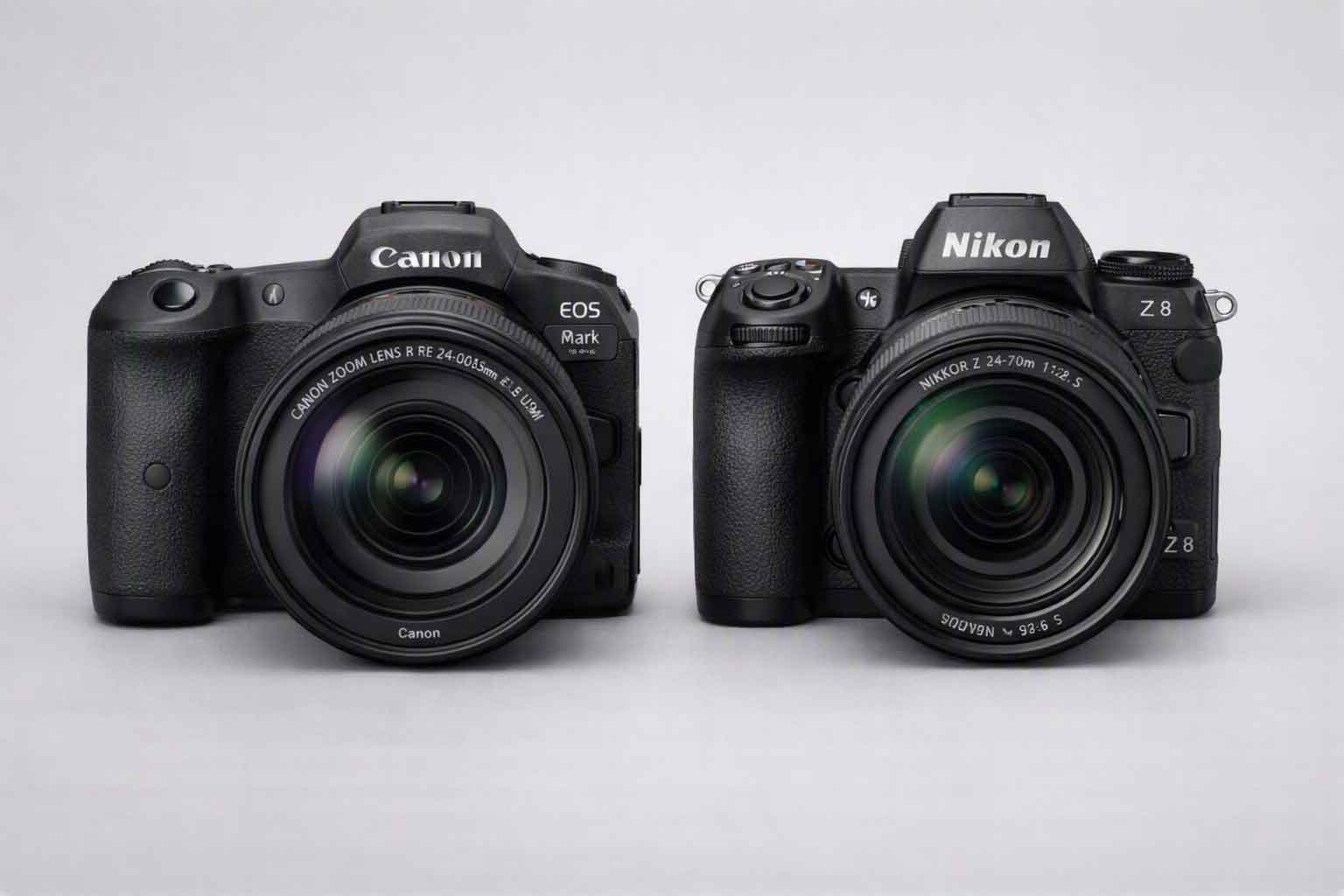
Specs at a Glance
| Specification | Canon EOS R5 Mark II | Nikon Z8 |
|---|---|---|
| Megapixels | 45 MP | 45.7 MP |
| Sensor Type | Full-Frame Stacked BSI-CMOS | Full-Frame Stacked BSI-CMOS |
| Autofocus Points | 1,053-zone DPAF III + AI chip | 493-point PDAF + AI |
| Subject Detection | Humans, animals, vehicles, more | 6 AI categories |
| Burst Rate | 30 fps (electronic) | 20 fps RAW |
| Max Video | 8K/60p RAW internal | 8K/30p RAW internal |
| Stabilization | 8.5-stop IBIS | 6-stop IBIS |
| Active Cooling | Yes (built-in fan) | No |
| Viewfinder | 5.76M-dot EVF | 3.69M-dot EVF |
| Battery Life | ~490 shots | ~340 shots (1,340 w/ grip) |
| Body Weight | 746 g | 910 g |
| Weather Sealing | Yes | Yes (IP53) |
| Price (MSRP) | $4,299 | $3,997 |
Introduction
Both the Canon EOS R5 Mark II and the Nikon Z8 are stacked-sensor full-frame mirrorless cameras designed for professional work. Both record 8K RAW internally. Both offer AI-driven subject recognition autofocus. Both weather-seal to professional standards. Yet they make fundamentally different choices in nearly every area — and those differences determine which camera is right for you.
The Canon commands a $302 premium over the Nikon, but brings a built-in active cooling fan, 8K/60p (versus Nikon's 8K/30p), and the RF mount's extraordinary lens lineup. The Nikon counters with superior ergonomics, IP53 sealing, better battery life, and a more intuitive physical control layout that experienced Nikon shooters will feel immediately at home with.
Design & Ergonomics
The Canon EOS R5 Mark II is lighter at 746 g versus the Nikon Z8's 910 g, and its compact body with a deep grip balances well with mid-size RF lenses. The built-in cooling fan is a headline feature that eliminates overheating worries during extended video shoots — a practical advantage that has real-world impact on long-duration production work. The 5.76M-dot EVF is sharp and large, making manual focus and critical framing easy.
The Nikon Z8 is heavier and larger, deliberately designed to accommodate the Z9's control scheme. The physical joystick, dedicated video record button, and highly customizable function button layout reward professionals who spend time configuring their camera to precise specifications. The IP53 dust and drip-resistance rating is more rigorous than Canon's generic "weather resistant" designation — a meaningful distinction for outdoor and event work.
Image Quality
Both cameras use approximately 45-megapixel stacked BSI-CMOS sensors, and both deliver images that are difficult to separate in blind testing. Canon's color science — particularly the skin tone rendering with Canon Log 3 and the new Neutral Picture Style — is outstanding. DPAF III's subject-linked metering also affects exposure consistency in a positive way: faces are rarely blown out even in tricky backlit conditions because the metering is tied directly to the AF subject.
Nikon's sensor produces slightly better high-ISO performance in our tests, with a cleaner noise structure at ISO 12800 and above. At base ISO, both cameras are extraordinary. Nikon's flat color profiles provide excellent latitude for grading, and the new Nikon Picture Controls give creative options without requiring a full log workflow.
At ISO 6400 and below: essentially a tie. Above ISO 12800: slight Nikon advantage in noise structure. Both cameras are fully capable of demanding commercial work.
Autofocus
Canon's DPAF III with a dedicated AI chip is the single most technologically advanced autofocus system available in a consumer mirrorless camera. The 1,053 zone Dual Pixel coverage spans virtually the entire sensor frame, and the dedicated AI accelerator processes subject recognition at a rate that noticeably reduces hunting and subject loss compared to previous generations. For sports, wildlife, and documentary work where subject behavior is unpredictable, the Canon's AF is a meaningful competitive advantage.
Nikon's 493-point PDAF in the Z8 is strong — competitive with any camera except the R5 Mark II and Sony A7 V at the top of the market. It tracks reliably through moderate chaos and handles six subject categories with confidence. Where it falls behind Canon is in high-speed multi-subject environments: when two athletes cross frame simultaneously or a bird bank-turns unexpectedly, Canon's wider coverage and more aggressive prioritization recovers faster.
Winner: Canon EOS R5 Mark II. The DPAF III with dedicated AI chip is the best autofocus in the business in 2026.
Video
The Canon EOS R5 Mark II is a cinema powerhouse. Internal 8K/60p RAW — the highest frame rate available at this resolution in any hybrid mirrorless — makes it the go-to choice for high-frame-rate 8K delivery or extreme slow-motion at 4K via downscale. The active cooling fan eliminates recording time limits that plagued earlier Canon cameras. Cinema RAW Light is a proven codec in professional post pipelines, and Canon Log 3 is supported natively in DaVinci Resolve and Premiere Pro.
The Nikon Z8 records 8K/30p RAW internally — outstanding, but limited to 30fps. For standard cinema work and broadcast, 30fps is sufficient. The Z8 also records N-RAW, Nikon's proprietary compressed RAW format, which produces smaller files than Canon Cinema RAW Light at comparable quality. Both cameras handle 4K/120p for slow-motion via downscale from 8K.
Winner: Canon EOS R5 Mark II — 8K/60p, active cooling fan, and a more established cinema codec ecosystem give it a clear edge for production work.
Battery Life
The Canon R5 Mark II delivers approximately 490 shots per charge — solid for professional work, though the power-hungry active cooling fan and 8K recording modes consume battery faster during video use. Nikon's Z8 body-only rates at around 340 shots, lower than expected at this price point.
With the MB-N12 power battery pack, the Z8 extends to approximately 1,340 shots — far ahead of any single-body competition. Professional photographers who routinely shoot events or long wedding days with vertical grip configurations will strongly favor the Nikon setup. The Canon has no comparable official vertical grip option at the same battery multiplication factor.
Winner: Nikon Z8 (with grip) for professional endurance; Canon for lighter carry.
Lens Ecosystems
Canon's RF mount has the most complete high-end native lens lineup in full-frame mirrorless. The RF 28-70mm f/2L, RF 85mm f/1.2L, RF 100mm f/2.8L Macro, and RF 70-200mm f/2.8L IS represent the best zoom-and-prime combination available from any manufacturer. Third-party support from Sigma and Tamron is growing, though still behind Sony E-mount in breadth.
Nikon's Z-mount has the largest throat diameter, enabling optical designs impossible on other mounts. The NIKKOR Z 58mm f/0.95 Noct remains a unique luxury item; the 24-70mm f/2.8 S and 70-200mm f/2.8 S are world-class zooms. Third-party Z-mount options from Sigma and Viltrox have improved the value equation significantly since 2024.
Winner: Canon EOS R5 Mark II — RF mount's current breadth and quality ceiling is unmatched, with L-series glass setting the standard.
Value
At $4,299, the Canon R5 Mark II is $302 more expensive than the Nikon Z8. For that premium, you get 8K/60p, a built-in cooling fan, DPAF III, and one of the finest EVFs in the industry. The Nikon returns better battery life (with grip), IP53 sealing, and arguably better ergonomics for serious professionals. Neither camera offers poor value — both are exceptional — but the Canon asks more and delivers more in the areas that matter most to video producers and sports photographers.
Winner: Nikon Z8 — lower price for comparable image quality and serious professional build.
Final Verdict
The Canon EOS R5 Mark II is the overall winner for most professional use cases. Its autofocus is best-in-class, its 8K/60p capability is unmatched in the hybrid mirrorless segment, and the RF lens ecosystem gives it the best glass options available. If your work spans sports, wildlife, commercial portraiture, and high-end video — the R5 Mark II does everything at an elite level.
The Nikon Z8 makes a compelling case for photographers coming from Nikon systems, those who prioritize ergonomics and IP53 durability, or shooters who find the grip-extended battery configuration essential for day-long events. It costs less and delivers comparable image quality — a legitimate professional tool with a well-stocked lens ecosystem.
Choose the Canon EOS R5 Mark II if: 8K/60p, DPAF III autofocus, and RF glass define your professional workflow. Choose the Nikon Z8 if: ergonomics, IP53 sealing, Z-mount optics, and lower price fit your priorities.