Fujifilm X-T5 Review
The 40MP APS-C powerhouse that puts image quality above everything else
Mirrorless · APS-C
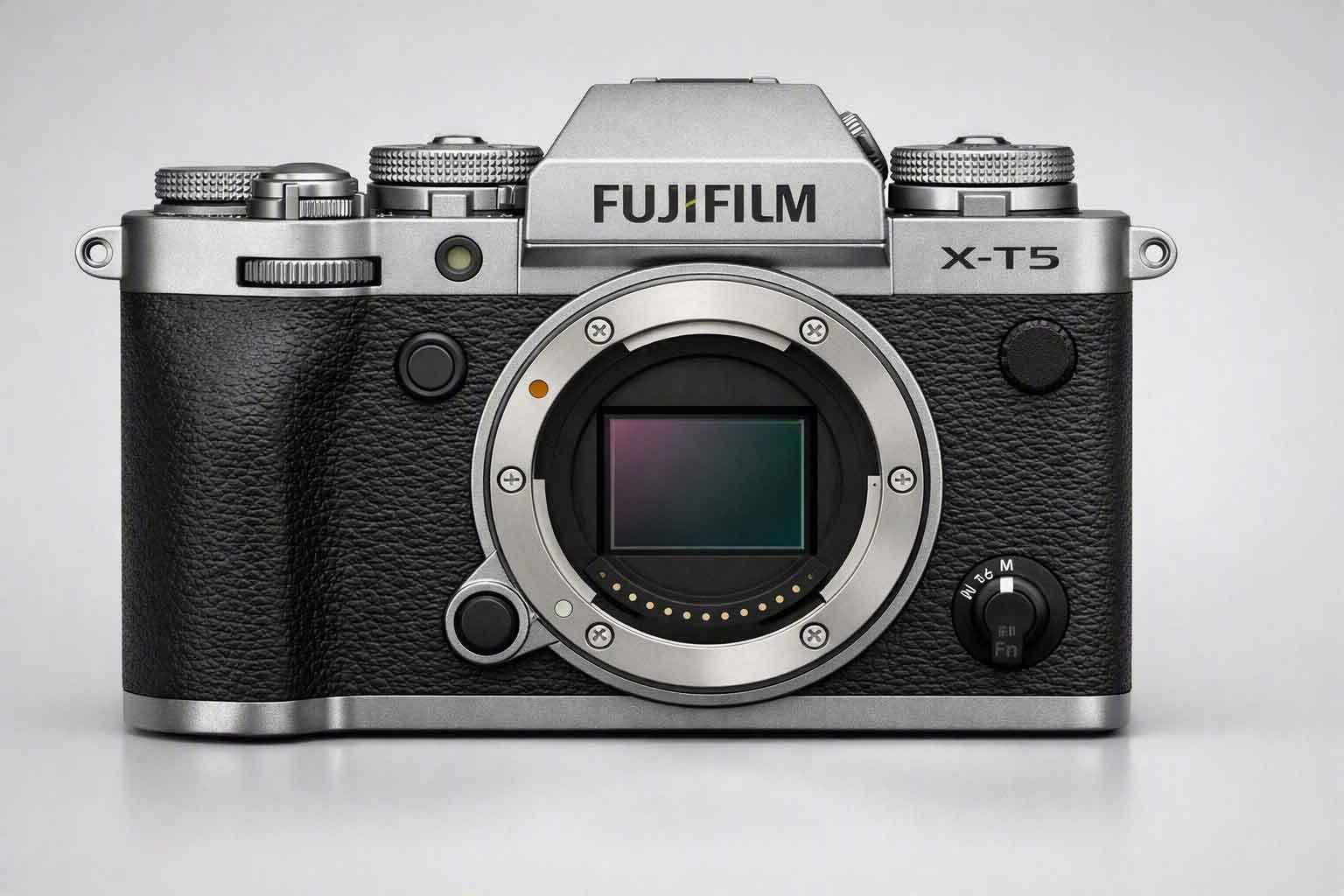
The Fujifilm X-T5 is built around a single conviction: that photographers deserve the highest possible image quality in a compact, beautifully made body, and that image quality means more megapixels, better dynamic range, and the finest color rendering available in the APS-C format — not more video modes, not more connectivity features, not a touchscreen designed for content creators. The 40.2MP X-Trans CMOS 5 HR sensor paired with X Processor 5 is the highest-resolution APS-C sensor in any mirrorless camera at $1,699, and it is not close. The nearest APS-C competitor reaches 26MP. The X-T5 delivers 57% more resolution.
That resolution advantage has real consequences for print photographers, landscape shooters, studio portraitists, and fine art photographers who demand the maximum detail from their system without stepping up to the weight, cost, and lens investment of a full-frame kit. The X-T5's classic dial-based exposure controls — dedicated dials for shutter speed, ISO, and exposure compensation on the top plate — give experienced photographers a tactile, direct relationship with the camera that modern touchscreen-centric interfaces rarely match. Add 7-stop IBIS, 15fps mechanical burst, weather sealing, and F-Log2 video, and the X-T5 makes a complete argument for itself at its price. It is Fujifilm's finest photographer's camera.
Design & Ergonomics
The X-T5 returns to the compact, stills-focused form factor of the original X-T series, deliberately stepping back from the larger, video-oriented X-T4. At 557g, it is meaningfully lighter than the X-T4's 607g, and the dimensions have been reduced to the point where the X-T5 fits comfortably in a jacket pocket with a compact prime attached. The top plate carries the three-dial exposure system — shutter speed on the right, ISO on the left, exposure compensation between — providing direct physical access to the primary exposure triangle without a single menu dive.
The 3.69M-dot OLED EVF at 0.75× magnification is among the finest viewfinders in any APS-C camera. At this resolution and magnification, fine detail in the scene is resolved in the finder, manual focus with peaking is highly accurate, and the overall optical experience is closer to a full-frame viewfinder than most APS-C cameras achieve. The 3-way tilting LCD — tilting up, down, and to portrait orientation — serves the needs of landscape and portrait photographers shooting from tripod and ground level. It does not flip fully to face the shooter for self-recording, which is the deliberate trade-off Fujifilm made in prioritizing the X-T5's photography orientation over creator versatility.
Image Quality
The 40.2MP X-Trans CMOS 5 HR sensor is Fujifilm's finest achievement in APS-C image quality to date. At base ISO 125, the resolving power is extraordinary — fine detail in fabric texture, foliage, architectural elements, and skin pores at portrait distances is captured with a clarity that requires a loupe to fully appreciate at 100% crop. The X-Trans filter array's distinctive color rendering — wider color separation than Bayer pattern sensors at equivalent megapixels — gives the X-T5's files a color accuracy and tonal depth that experienced photographers immediately recognize as characteristic of Fujifilm's best output.
The 20 film simulations at 40MP resolution represent the X-T5's most creatively powerful feature. A Velvia JPEG at 40MP has exhibition print capability at sizes exceeding 30 inches on the long edge. Acros monochrome at 40MP captures a grain structure and tonal range in shadows and highlights that rivals medium-format film scanning in trained hands. Classic Chrome at 40MP produces travel and documentary images that require no post-processing for publication. At ISO 3200, the X-Trans noise pattern reads as fine grain rather than color noise, maintaining the film-like character that makes Fujifilm's high-ISO output distinctively pleasing. At ISO 6400–12800, detail is progressively traded for grain, but the output remains artistically useful.
Autofocus
The X-T5's 425-point hybrid phase-detect and contrast-detect AF system — shared with the X-S20 and X100VI — performs reliably for the X-T5's primary audience of deliberate, technically engaged photographers. Human, Animal, and Bird subject detection works accurately in good light, with eye priority maintaining reliable tracking through portrait-distance sessions and controlled outdoor work. For street photography at moderate subject speeds, landscape shooting with occasional moving foreground elements, and portrait sessions with predictable subject movement, the AF handles everything confidently.
At the edge of its operational envelope — fast birds in flight, unpredictable action, motorsports — the X-T5's phase-detect system is less competitive than Sony's 759-point BIONZ XR implementation or Canon's DPAF III. This is a knowable limitation for photographers considering the X-T5 specifically for fast-action work; the A6700 or Canon EOS R5 Mark II are better choices for that use case. For the photography the X-T5 is designed for — landscape, portraiture, street, travel, studio — the AF is thoroughly capable and dependable.
Video Performance
The X-T5's video capabilities are genuinely strong despite the camera's photographer-first positioning. 6.2K/30p from the full sensor width, oversampled 4K/60p — downsampled from 6.2K for exceptional quality — and F-Log2 capturing 13+ stops of dynamic range position the X-T5 as a capable hybrid tool for photographers who also need video delivery. The 7-stop IBIS in video mode produces smooth handheld footage at moderate movement speeds, and F-Log2's color science feeds cleanly into professional grading pipelines.
The 3-way tilting LCD is the primary video ergonomic limitation: it cannot face the shooter for self-recording, making solo vlogging with the X-T5 less practical than with cameras equipped with fully articulating screens. For tripod-based interview work, B-roll from a fixed position, and operator-controlled production, the X-T5 is a capable and versatile video tool. For run-and-gun documentary work or self-recording creators, the X-S20 or X100VI are better choices within the Fujifilm lineup. The micro-HDMI output supports external recording for productions requiring maximum quality pathways.
Pros & Cons
Pros
- 40.2MP X-Trans CMOS 5 HR is the highest resolution APS-C sensor in any mirrorless camera at this price
- 7-stop IBIS enables sharp handheld shooting at shutter speeds that previously required a tripod
- 20fps electronic burst with 425-point phase-detect AF covers demanding action and wildlife scenarios
- 6.2K/30p and oversampled 4K/60p with F-Log2 delivers professional video quality from a compact body
- Classic dial-based exposure controls provide direct, tactile access to ISO, shutter speed, and exposure compensation
- Dual SD UHS-II slots provide professional-grade redundancy and fast buffer clearing
- Weather sealing gives confidence across outdoor shooting conditions and mixed weather
- 20 Fujifilm film simulations produce exhibition-quality JPEGs straight from camera at 40MP resolution
Cons
- No fully articulating LCD — 3-way tilt is excellent for still photography but less versatile for solo video creators
- Micro-HDMI port is fragile under cable tension — a right-angle adapter is a strongly recommended accessory
- ISO ceiling of 12800 native trails full-frame cameras in extreme low-light conditions
- X-T5's stills-photography focus means video ergonomics require additional rigging for serious production work
- At $1,699, the X-T5 faces serious competition from full-frame options that are only marginally more expensive
Full Specifications
| Sensor | 40.2 MP X-Trans CMOS 5 HR, APS-C |
|---|---|
| Processor | X Processor 5 |
| Autofocus Points | 425 hybrid AF points (phase + contrast) |
| Subject Detection | Human, Animal, Bird |
| Burst Rate | 20 fps (electronic) / 15 fps (mechanical) |
| Video | 6.2K/30p; 4K/60p oversampled from 6.2K; F-Log2 |
| Stabilization | Up to 7-stop IBIS |
| ISO Range | 125–12800 (expandable 64–51200) |
| Viewfinder | 3.69M-dot OLED, 0.75× magnification |
| LCD | 3.0″ 3-way tilting touchscreen, 1.84M dot |
| Battery Life | ~580 shots (CIPA) |
| Card Slots | 2× SD UHS-II |
| Connectivity | Wi-Fi, Bluetooth, USB-C, micro-HDMI |
| Body Weight | 557 g (with battery) |
| Weather Sealing | Yes — dust and moisture resistant |
| Price (MSRP) | $1,699 body only |
Final Verdict
The Fujifilm X-T5 is the finest photographer's camera in the APS-C format, and one of the most compelling cameras at any price for image-quality-obsessed shooters who want the smallest possible body carrying the most possible resolution. At 40.2MP with 7-stop IBIS, X-Trans color science, 20 film simulations, dual UHS-II slots, weather sealing, and a classic dial-based control system, the X-T5 represents Fujifilm's engineering at its best. It is not the camera for every photographer — those who prioritize fast-action tracking, video creator ergonomics, or full-frame low-light performance have better alternatives. But for landscape photographers, portrait artists, travel documentarians, and anyone who prints large and demands technical excellence in their files, the X-T5 is the APS-C camera to own in 2026.
Check Price on Amazon