Fujifilm X-S20 Review
The best mid-range APS-C mirrorless — film simulations, 750-shot battery, and 6.2K video under $1,300
Mirrorless · APS-C
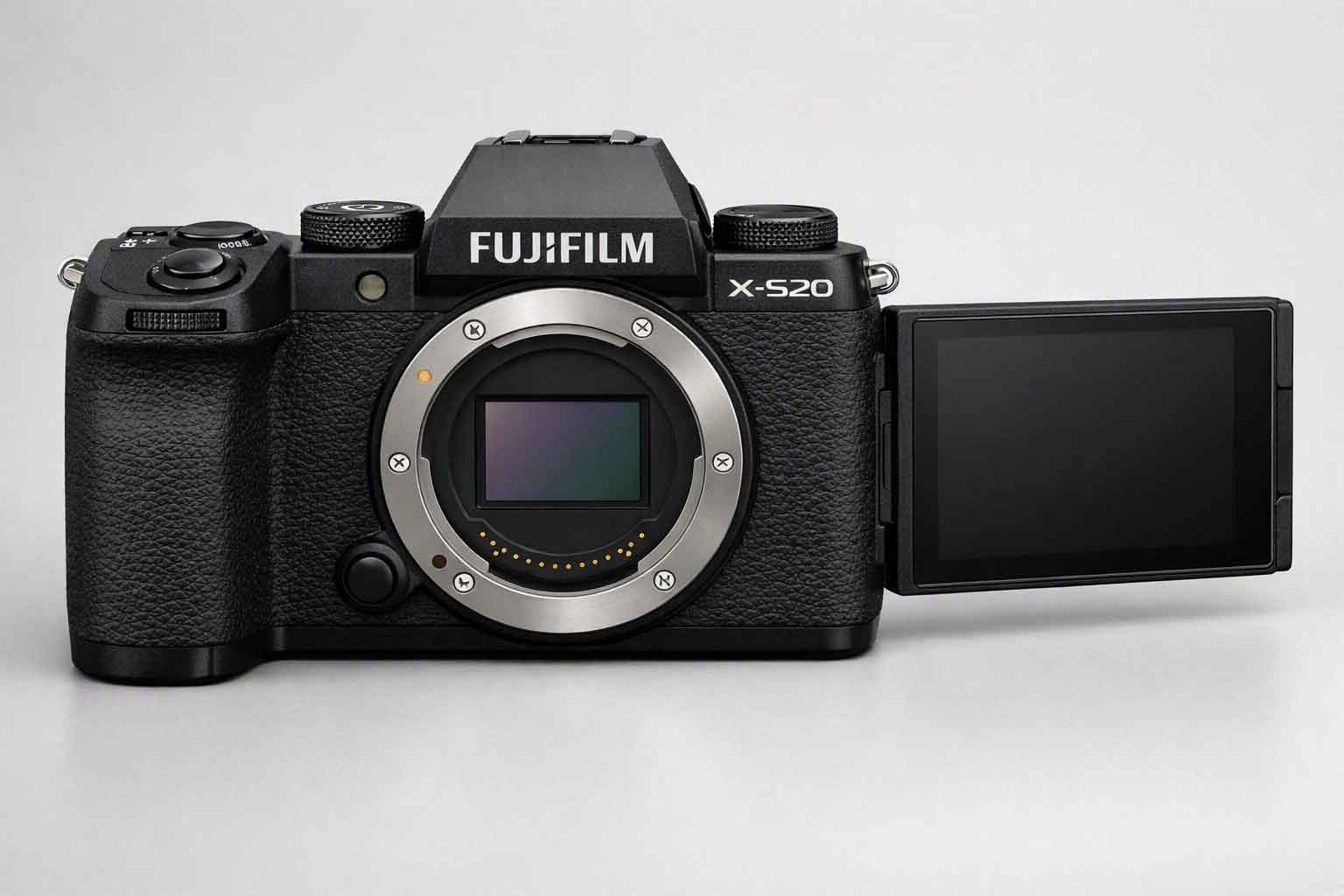
The Fujifilm X-S20 occupies the sweet spot of the APS-C mirrorless market: more capable than entry-level cameras, more affordable than the flagship tier, and uniquely strong in the areas that matter most to the photographers and video creators most likely to buy it. The ~750-shot battery life is not just a spec sheet number — it is, in practical terms, the most useful upgrade from the X-S10 it replaced, and it remains unmatched at this price point across any brand. Pair that with 6.2K/30p video, F-Log2, oversampled 4K/60p, 7-stop IBIS, and the full X Processor 5 speed with subject tracking AF, and the X-S20 becomes very difficult to argue against at $1,299.
Fujifilm's film simulation system — 20 modes including Provia, Velvia, Acros, Classic Chrome, Eterna, and Nostalgic Neg — gives the X-S20 an image character that no spec sheet fully captures. JPEGs produced in-camera with tuned film simulations stand alongside processed RAW files from competing cameras in quality and creative expressiveness. For photographers who prioritize finished output straight from the camera, this alone justifies serious attention. For video creators who need F-Log2 dynamic range at a price well below the professional tier, the X-S20 is one of the most compelling hybrid choices available.
Design & Ergonomics
Fujifilm positioned the X-S20 with a conventional DSLR-style grip and body design rather than the dial-centric rangefinder layout of the X-T series. This makes it more accessible to photographers transitioning from Canon or Nikon DSLRs — the familiar shutter/aperture/ISO controls via conventional dials and menu system rather than dedicated physical exposure dials reduces the learning curve considerably. The deep, well-contoured grip is among the most comfortable in the APS-C segment at 491g.
The fully articulating 3.0-inch touchscreen is excellent — 1.84M dots, touch-to-focus and touch-to-shoot in video mode, and fully flip-out for self-facing vlogging and low-angle stills. The 2.36M-dot OLED EVF at 0.62× magnification is smaller than the X-T5's 3.69M-dot finder but well-suited to the X-S20's more casual ergonomics. The single SD UHS-I card slot is a spec that feels increasingly constrained in 2026 — a UHS-II slot would better match the camera's 6.2K video capabilities — but in practice the camera's buffer management is reasonable for typical shooting.
Image Quality
The 26.1MP X-Trans CMOS 4 sensor produces excellent image quality in the ISO 160–3200 range, where the X-Trans filter array's distinctive color rendering and the absence of a low-pass filter combine for clean, detailed output that has a film-like quality that Bayer-pattern sensor cameras rarely match. At ISO 6400, the X-S20 maintains good detail with luminance noise that reads as grain rather than smear, and at ISO 12800, JPEGs with Fujifilm's built-in noise reduction remain usable for social media and moderate print sizes.
RAW files via Adobe Lightroom, Capture One, or Iridient Developer unlock the full detail of the X-Trans array for critical print work. The 20 film simulations represent one of Fujifilm's most significant product differentiators: Velvia's punchy landscape saturation, Acros's luminous monochrome rendering, Classic Chrome's muted travel aesthetic, and Eterna's flat video-optimized look all produce distinct and artistically useful output directly from the camera's JPEG engine. For photographers who shoot JPEG as a primary workflow, the X-S20 produces results that rival processed RAW files from many competitors.
Autofocus
The X-S20's 425-point hybrid phase-detect and contrast-detect system, powered by X Processor 5, is a meaningful step forward from earlier X-series AF performance. Human, Animal, and Bird subject detection operates reliably in good light, with eye-level priority working correctly for portraits and close-in documentary work. Tracking through moderate subject motion — walking subjects, pets, children in structured play — is consistent and confident. For the primary use cases of the X-S20's target audience, the AF is fully adequate.
At the limits of the system — fast sports, birds in rapid flight, unpredictable action — the X-S20's AF is outperformed by Sony's 759-point phase-detect system in the A6700 and Canon's DPAF III in the R5 Mark II. This is not a practical concern for most photographers: the X-S20 is designed for hybrid creators, street photographers, travelers, and portrait shooters, and in those use cases the AF tracks reliably. Video AF in particular is smooth and natural — the transition speed can be tuned to suit cinematic or documentary aesthetics.
Video Performance
The X-S20's video capabilities represent a genuine step forward for mid-range APS-C: 6.2K/30p from the full sensor, oversampled 4K/60p with no crop factor beyond the APS-C format, and F-Log2 capturing 13+ stops of dynamic range for professional grading workflows. At 4K/60p, the X-S20 produces some of the cleanest oversampled output available under $1,500 — the 6.2K native resolution downsampled to 4K provides a level of detail that straight-pixel-read 4K cameras cannot match.
The 7-stop IBIS in video mode is genuinely effective — walking shots with moderate pace are stabilized to a smoothness that approaches gimbal-assisted footage in short sequences. The fully articulating screen makes it practical for single-operator productions across a wide range of shooting angles, and the Vlog Creator mode simplifies the technical setup for content creators who need reliable results without manual configuration. At $1,299, the X-S20 offers video specifications that, combined with Fujifilm's color science, make it one of the strongest value propositions in hybrid cameras.
Pros & Cons
Pros
- ~750 shot CIPA battery life is the best of any camera under $2,000 — shoot all day on one charge
- 6.2K/30p and oversampled 4K/60p video quality rivals cameras at twice the price
- F-Log2 provides 13+ stops of dynamic range for professional color grading workflows
- 7-stop IBIS delivers exceptional handheld stability for both stills and video
- 20 Fujifilm film simulations produce gallery-quality JPEGs straight from the camera
- 491 g compact body makes it comfortable for all-day street, travel, and event use
- X Processor 5 delivers fast, accurate AF subject detection for Human, Animal, and Bird
Cons
- No weather sealing — the X-S20 needs protection in rain and dusty conditions
- UHS-I single card slot limits burst buffer write speed compared to UHS-II equipped competitors
- X-Trans CMOS 4 (not the newer 5 HR) means the sensor trails X-T5 in resolving power
- Micro-HDMI port is fragile under cable stress — a cable with a right-angle adapter is recommended
- EVF at 0.62× magnification is smaller than Fujifilm's higher-tier body offerings
Full Specifications
| Sensor | 26.1 MP X-Trans CMOS 4, APS-C |
|---|---|
| Processor | X Processor 5 |
| Autofocus Points | 425 hybrid AF points (phase + contrast) |
| Subject Detection | Human, Animal, Bird |
| Burst Rate | 20 fps (electronic) / 8 fps (mechanical) |
| Video | 6.2K/30p; 4K/60p oversampled from 6.2K; F-Log2 |
| Stabilization | Up to 7-stop IBIS |
| ISO Range | 160–12800 (expandable 80–51200) |
| Viewfinder | 2.36M-dot OLED EVF, 0.62× magnification |
| LCD | 3.0″ fully articulating touchscreen, 1.84M dot |
| Battery Life | ~750 shots (CIPA) — best in class |
| Card Slots | 1× SD UHS-I |
| Connectivity | Wi-Fi, Bluetooth, USB-C, micro-HDMI |
| Body Weight | 491 g (body only) |
| Weather Sealing | None |
| Price (MSRP) | $1,299 body only |
Final Verdict
The Fujifilm X-S20 is the best mid-range APS-C mirrorless camera for hybrid photographers and content creators in 2026. Its 750-shot battery life alone sets it apart from every competitor at this price; add 6.2K/30p video, oversampled 4K/60p, F-Log2, 7-stop IBIS, and Fujifilm's unmatched film simulation system, and the value proposition is remarkably strong. The single UHS-I card slot and absence of weather sealing are real constraints for professional deployment, but for the vast majority of photographers and creators the X-S20 covers, these limitations are rarely operationally significant. At $1,299, it is the mid-range Fujifilm to recommend.
Check Price on Amazon