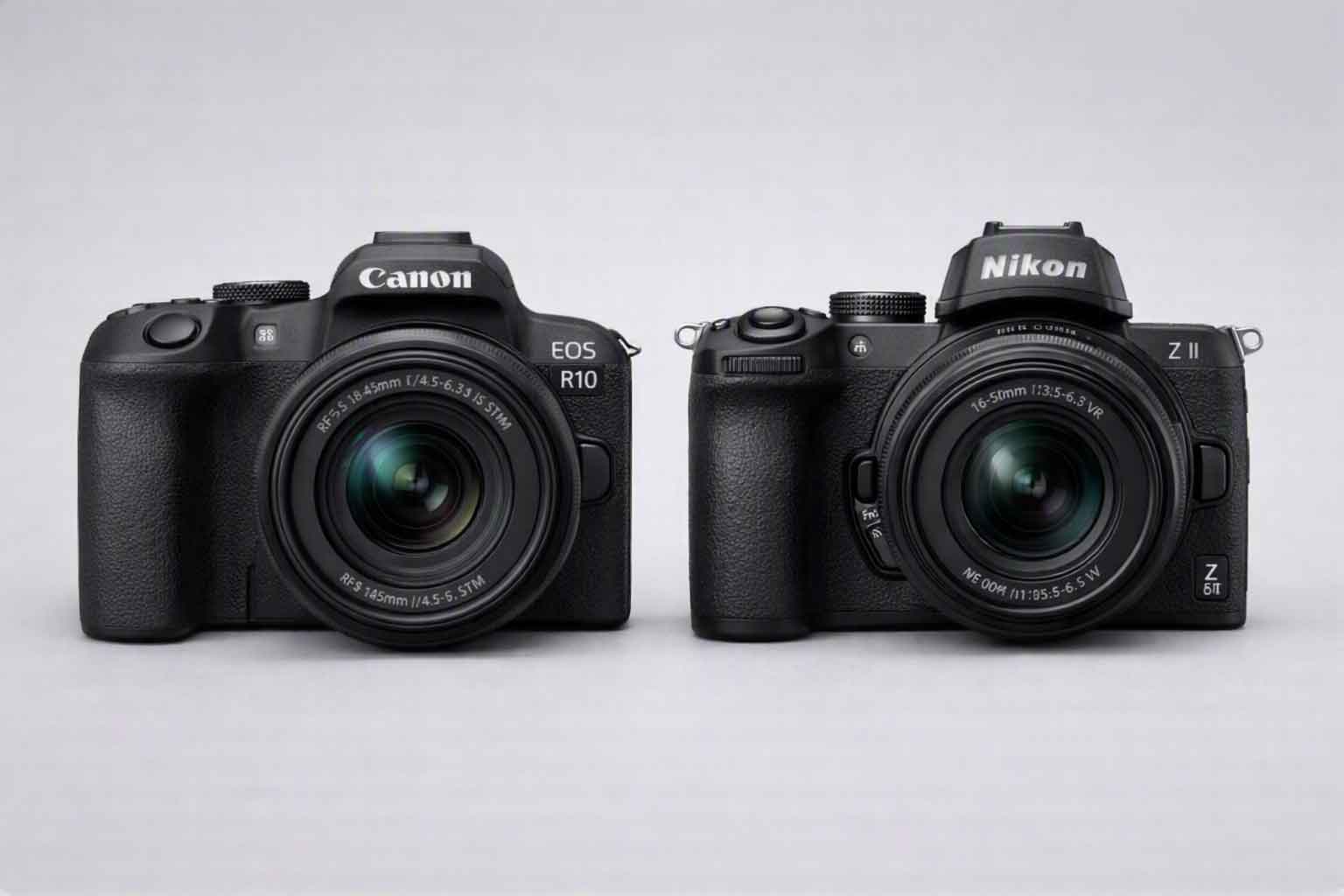
Specs at a Glance
| Specification | Canon EOS R10 | Nikon Z50 II |
|---|---|---|
| Megapixels | 24.2 MP | 20.9 MP |
| Sensor Type | APS-C CMOS | APS-C BSI-CMOS |
| Processor | DIGIC X | EXPEED 7 |
| Autofocus Points | 651-zone DPAF II | 405-point PDAF (EXPEED 7) |
| Subject Detection | Human, Animal, Vehicle | Human, Animal, Vehicle |
| Burst Rate | 23 fps (electronic) | 30 fps (electronic) |
| Max Video | 4K/30p (from 6K) | 4K/60p (no crop); N-Log |
| IBIS | None | None |
| LCD | Fully articulating touch | Tilting touch |
| Battery Life | ~430 shots | ~300 shots |
| Body Weight | 429 g | 395 g |
| Weather Sealing | No | No |
| Price (MSRP) | $799 | $849 |
Introduction
The Canon EOS R10 and the Nikon Z50 II sit within $50 of each other — close enough that price alone won't make your decision. Both are compact, lightweight APS-C mirrorless cameras aimed at photographers upgrading from a smartphone or entry-level DSLR. Both offer AI-powered subject detection, 4K video, and access to a growing ecosystem of native lenses. But they make different engineering trade-offs, and understanding those differences will point you clearly toward the right choice.
The R10 leverages Canon's DPAF II autofocus system, fully articulating LCD, and a proven sub-$800 price. The Z50 II brings Nikon's latest EXPEED 7 processor, 4K/60p without crop, and N-Log for serious video work — at $849. For a first mirrorless camera, either choice is strong. For a specific type of shooter, one is clearly better.
Design & Ergonomics
The Canon EOS R10 at 429 g is compact and comfortable for its size class. The grip is generous enough for a full-hand hold with most lenses, and the mode dial, quick-access button layout, and fully articulating touchscreen make it intuitive out of the box — ideal for photographers coming from smartphones who want familiar touchscreen navigation. Neither camera offers weather sealing, which is expected at this price tier.
The Nikon Z50 II at 395 g is the lighter of the two. It has a slightly smaller overall footprint, but the grip is notably deep and comfortable — one of the best in its class by ergonomic standards. The tilting (non-fully-articulating) LCD is a limitation for self-portrait and solo vlogging work, but for conventional shooting it positions well. Physical dials are well-labeled and intuitive for Nikon-experienced shooters.
Image Quality
The Canon R10's 24.2MP sensor produces images with Canon's characteristic color science — warm, accurate skin tones and clean highlights that translate well directly from JPEG without post-processing. DIGIC X processing handles noise competently up to ISO 3200; above that, luminance noise becomes visible but manageable with light processing. The extra megapixels versus the Nikon give it a slight resolution advantage for cropping and large prints.
The Nikon Z50 II's 20.9MP BSI-CMOS sensor benefits from the backside-illuminated architecture — it captures slightly more light per pixel than the Canon's conventional CMOS design, which translates to marginally cleaner high-ISO performance. EXPEED 7's noise reduction is noticeably more sophisticated than Canon's DIGIC X at this price, producing smoother gradients at high ISO. For low-light work, the Z50 II has a practical advantage.
For daylight and controlled-light photography at base ISO: essentially a tie. For low-light and high-ISO work: Nikon Z50 II has a slight edge. For resolution: Canon EOS R10 leads by approximately 16%.
Autofocus
Canon's Dual Pixel CMOS AF II is the R10's strongest competitive asset. The 651-zone coverage across the full APS-C frame delivers fast, confident subject acquisition with human, animal, and vehicle detection. Eye AF is reliable and consistent — the kind of autofocus performance that used to require spending two to three times more money. For family photographers, sports coverage, and pet photography, the R10's AF is a meaningful advantage at this price.
Nikon's EXPEED 7-powered PDAF system in the Z50 II performs well for general photography — portraits, travel, and casual action. The 405-point coverage is wide, and subject detection for humans and animals works reliably in good light. Where the Canon separates itself is in tracking persistence during fast, erratic movement: the DPAF II's full-frame coverage density makes it harder to lose a subject mid-action.
Winner: Canon EOS R10. DPAF II's tracking performance is best-in-class at this price point.
Video
The Nikon Z50 II takes a clear lead in video capability. 4K/60p without crop using the full APS-C frame — powered by EXPEED 7 — is a specification that most cameras at this price tier cannot match. N-Log support provides a flat, high-latitude color profile for grading in DaVinci Resolve or Premiere Pro, making the Z50 II a capable choice for semi-professional video work at an entry-level price. Slow-motion FHD at 120p rounds out the video spec sheet.
The Canon R10 records 4K/30p with a slight line-skipped crop from the 6K sensor readout, which softens fine detail versus the Nikon's full-pixel-readout 4K. Canon Log is not available on the R10 — you're limited to standard picture styles for color profiles, which constrains grading latitude significantly. FHD is available at 120p for slow motion.
Winner: Nikon Z50 II. 4K/60p, no-crop readout, and N-Log are meaningfully better video tools than the R10 offers at a comparable price.
Battery Life
The Canon R10 rates at approximately 430 shots per charge — solid for an entry-level APS-C mirrorless and enough for a full day of casual shooting on a single battery. The Nikon Z50 II rates at approximately 300 shots, noticeably lower — carry a spare battery for all-day shooting sessions.
Winner: Canon EOS R10 by a meaningful margin in practical all-day use.
Lens Ecosystems
Canon's RF-S mount — shared with the R10, R50, and R7 — is growing steadily, with purpose-built APS-C zooms like the RF-S 18-150mm f/3.5-6.3 offering versatile coverage. Full-frame RF lenses work natively on R10, giving access to Canon's exceptional L-series glass on an APS-C body. Third-party RF-S options from Sigma and Tamron are emerging.
Nikon's Z-mount DX lineup (APS-C) includes practical zoom options and is compatible with the full Z-mount lens catalog. Third-party Z-mount APS-C options from Viltrox provide fast primes at accessible price points — including a 23mm f/1.4 and 56mm f/1.4 that offer excellent value for portrait and low-light work.
Winner: Tie. Both ecosystems serve APS-C shooters adequately; both benefit from access to their full-frame mount counterparts.
Value
At $799, the Canon R10 is $50 cheaper and delivers better autofocus, a fully articulating LCD, more megapixels, and better battery life. For photographers whose priority is confident stills performance across fast-moving and everyday subjects, the R10's lower price combined with DPAF II makes it exceptional value.
The Nikon Z50 II at $849 earns its small premium with 4K/60p, N-Log, BSI sensor low-light performance, and ergonomics that feel premium for the price tier. For video-focused buyers and those who prioritize low-light stills, the extra $50 is well spent.
Winner: Canon EOS R10 on pure value per dollar for the majority of use cases.
Final Verdict
The Canon EOS R10 wins this comparison for photographers — its DPAF II autofocus, fully articulating LCD, extra megapixels, and better battery life make it the more versatile stills-first camera at a slightly lower price. For anyone upgrading from a smartphone or DSLR who wants the best autofocus in the entry-level APS-C class, the R10 is the clear recommendation.
The Nikon Z50 II is the right choice for video-focused buyers and low-light shooters. 4K/60p, N-Log, and BSI sensor performance give it a meaningful video advantage that the Canon simply can't match. If your primary output is video content and you want professional-grade color profiles without spending more, the Z50 II earns its spot.
Choose the Canon EOS R10 if: autofocus, stills performance, articulating LCD, and battery life drive your purchase. Choose the Nikon Z50 II if: 4K/60p video, N-Log, and BSI low-light performance are your priorities.