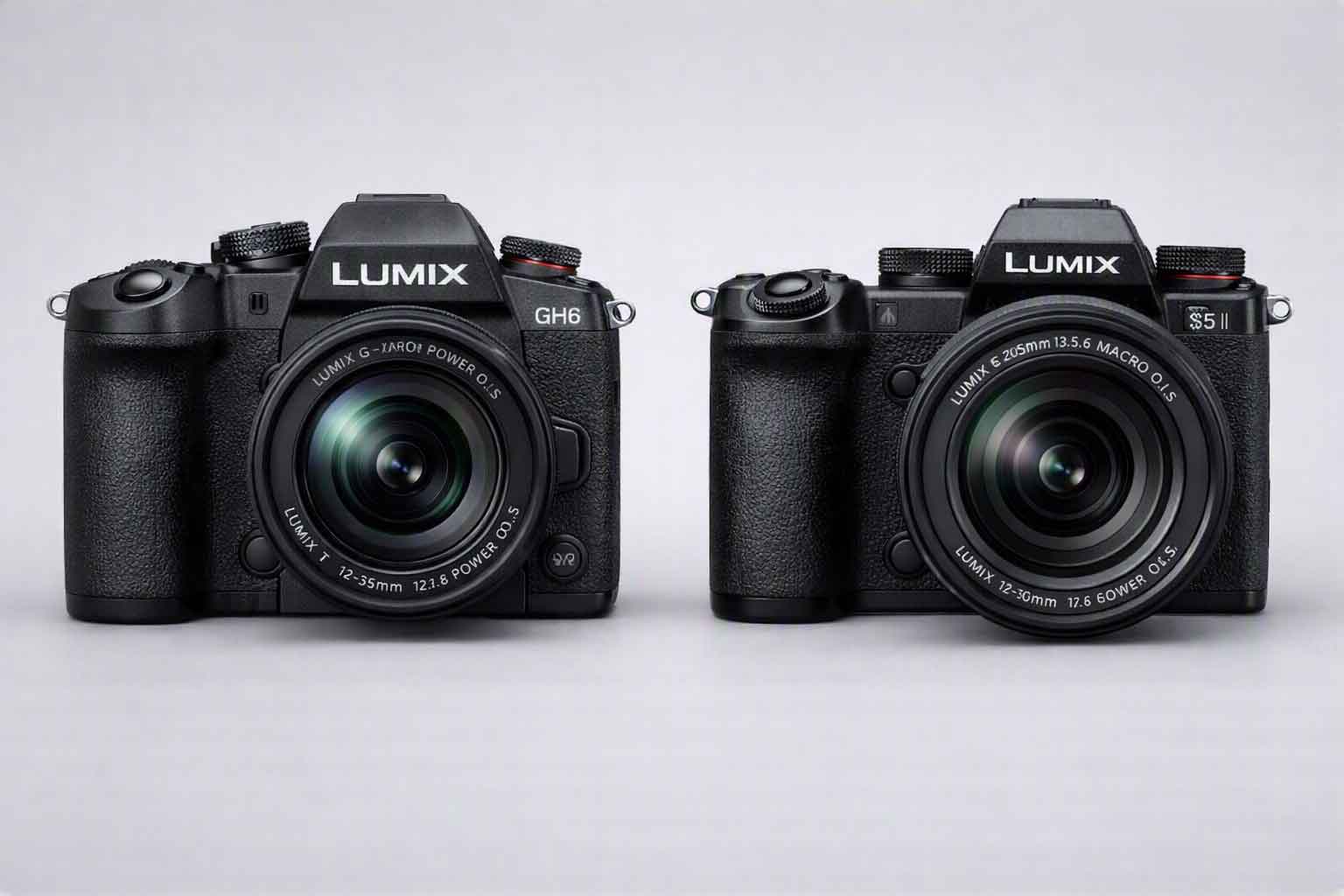
Specs at a Glance
| Specification | Panasonic GH6 | Panasonic Lumix S5 II |
|---|---|---|
| Megapixels | 25.2 MP | 24.2 MP |
| Sensor Format | Micro Four Thirds | Full-Frame BSI-CMOS |
| Autofocus System | DFD contrast-detect | 779-point PDAF + DFD hybrid |
| Burst Rate | 14 fps (mechanical) | 30 fps (electronic) |
| Max Video | 5.7K/60p; ProRes 422 HQ internal | 6K/30p open gate; V-Log L |
| Stabilization | 7.5-stop IBIS | 6.5-stop IBIS |
| Active Cooling | Yes (built-in fan) | No |
| Weather Sealing | Yes (to −10°C) | Yes |
| Card Slots | Dual SD UHS-II | Dual SD UHS-II |
| Battery Life | ~360 shots | ~470 shots |
| Body Weight | 739 g | 740 g |
| Price (MSRP) | $1,497 | $1,997 |
Introduction
Panasonic occupies a unique position in the camera market: the only manufacturer that actively develops two full hybrid camera lines at different sensor sizes. The GH6 is Panasonic's Micro Four Thirds video flagship — a compact, feature-rich camera with ProRes 422 HQ internal recording, 7.5-stop IBIS, an active cooling fan, and 5.7K/60p capture. The Lumix S5 II is Panasonic's full-frame entry-level professional — a 24.2MP full-frame hybrid with phase-detect autofocus (a first for Panasonic), 6K open-gate recording, and V-Log L color science.
The GH6 costs $500 less. They weigh nearly the same. For a Panasonic-committed shooter trying to decide between MFT and full-frame, this comparison represents a genuine fork in the road.
Design & Ergonomics
At 739 g versus 740 g, the GH6 and S5 II are among the closest-matched cameras by weight in any comparison. Both feel substantial and well-built in hand, with a deep grip, weather sealing, and dual SD UHS-II card slots. The GH6's compact MFT mount means smaller native lenses, which reduces the overall kit weight significantly — a 12-35mm f/2.8 MFT zoom is dramatically lighter than a comparable full-frame lens.
The GH6's active cooling fan gives it an advantage in sustained recording scenarios: 5.7K ProRes can run indefinitely without overheating. The S5 II lacks active cooling but manages thermal performance well through body design — it handles extended 4K recording without hitting limits in normal ambient temperatures.
Image Quality
The full-frame sensor in the Lumix S5 II delivers a fundamental advantage in two areas: low-light performance and depth of field control. The larger sensor captures more light per pixel, producing cleaner images at high ISO — the S5 II is usable at ISO 6400 to 12800 for demanding conditions. Equivalent aperture depth of field on full-frame gives photographers access to shallower backgrounds than the GH6's 2× crop factor allows at the same focal length and aperture combination.
The GH6's 25.2MP MFT sensor is excellent within its format constraints. At base ISO, its images are clean and detailed. Panasonic's Natural and Flat color profiles are accurate and film-friendly. The GH6's images begin to show noise more prominently above ISO 3200, which is a format limitation rather than a sensor design failure.
Winner: Panasonic Lumix S5 II. Full-frame physics deliver better high-ISO performance and depth of field control.
Autofocus
The Lumix S5 II introduced phase-detect autofocus to Panasonic's full-frame lineup — a significant engineering milestone. The 779-point PDAF combined with Panasonic's retained DFD (Depth from Defocus) contrast-detect system creates a hybrid AF architecture that performs well for portraits, events, and moderate-action subjects. It's a meaningful step up from the pure DFD systems in earlier Lumix cameras.
The GH6 uses DFD contrast-detect only — no phase-detect array. Panasonic's DFD is among the best contrast-detect systems available, but it lags behind phase-detect systems in tracking speed and subject acquisition in fast-moving scenarios. For video work — the GH6's primary use case — DFD performs adequately for most subjects, but fast sports and wildlife will challenge it.
Winner: Panasonic Lumix S5 II. Phase-detect AF is a material improvement for any action or event shooting.
Video
The GH6 is Panasonic's MFT video champion for a reason: it's the only camera in its price class with internal Apple ProRes 422 HQ recording. For productions that deliver in ProRes — broadcast, corporate, documentary — this eliminates the need for an external ProRes recorder costing thousands of dollars. 5.7K/60p provides excellent slow-motion at a high resolution that downscales cleanly to 4K delivery. The active cooling fan keeps it running indefinitely.
The Lumix S5 II's video suite is strong but differently focused. 6K open-gate recording (in the 3:2 ratio) provides maximum field coverage for post-production reframing — extremely useful for documentary and interview work where the operator can't always reposition between takes. V-Log L is a well-supported log profile in major post suites. The full-frame sensor's bokeh characteristics translate to noticeably more cinematic-looking video with equivalent lenses.
Winner: Panasonic GH6 for codec depth (ProRes 422 HQ). Lumix S5 II wins on cinematic full-frame video aesthetics.
Stabilization
The GH6's 7.5-stop IBIS rating is the highest in Panasonic's lineup — and notably stronger than the S5 II's 6.5-stop system. In real-world handheld video, this difference is perceptible: the GH6 can produce smooth, stable footage at walking pace without Active IS engaged, where the S5 II occasionally shows more residual motion. For handheld documentary and event work, the GH6's IBIS is a genuine competitive advantage.
Winner: Panasonic GH6. 7.5 stops is class-leading for an MFT body.
Value
The GH6's $1,497 price delivers an extraordinary feature set: ProRes 422 HQ internal, 7.5-stop IBIS, 5.7K/60p, active cooling, weather sealing to −10°C, and dual UHS-II cards. For video-first shooters on a budget, there is no better-equipped camera at this price. The S5 II at $1,997 costs $500 more for full-frame image quality, phase-detect autofocus, and a more versatile stills-video hybrid platform.
Winner: Panasonic GH6 on value per dollar for video-first shooters.
Final Verdict
The Panasonic Lumix S5 II is the overall winner because it delivers full-frame image quality, phase-detect autofocus, and a more versatile stills-and-video hybrid performance at a price point that remains accessible. For photographers and hybrid shooters who split time equally between stills and video, the S5 II's full-frame sensor and PDAF system are decisive advantages.
The Panasonic GH6 wins for video specialists. Internal ProRes 422 HQ, 7.5-stop IBIS, active cooling, and a $500 lower price make it the most capable dedicated video camera under $1,500. If your primary output is video and you work in controlled lighting where full-frame low-light performance is not critical, the GH6 is the more cost-effective professional choice.
Choose the Panasonic GH6 if: ProRes internal recording, maximum IBIS, and a lower price define your video workflow. Choose the Panasonic Lumix S5 II if: full-frame image quality, phase-detect AF, and a stills-video hybrid platform are your priorities.